


Address / Local links: 195 Brampton Road, Bexleyheath
Family / Relatives: Husband of Hilda
Other Information: An Engineering Company Clerk
HMS Prince of Wales
Winston Churchill described the sinking of HMS Prince of Wales in December 1941 as the greatest shock of his life…
“I was opening my boxes,” Churchill wrote in his war memoirs “when the telephone at my bedside rang. It was the First Sea Lord [Admiral Sir Dudley Pound]. His voice sounded odd. He gave a sort of cough and gulp, and at first I could not hear quite clearly. ‘Prime Minister, I have to report to you that the Prince of Wales and the Repulse have both been sunk by the Japanese—we think by aircraft. [Vice Admiral] Tom Phillips is drowned.’ ‘Are you sure it’s true?’ ‘There is no doubt at all.’ So I put the telephone down. I was thankful to be alone. In all the war I never received a more direct shock. The reader of these pages will realise how many efforts, hopes, and plans foundered with these two ships. As I turned over and twisted in bed the full horror of the news sank in upon me. There were no British or American capital ships in the Indian Ocean or the Pacific except the American survivors of Pearl Harbour, who were hastening back to California. Over all this vast expanse of waters Japan was supreme, and we everywhere were weak and naked.”…
“The battleship Prince of Wales was the second ship of the King George V class. In May 1941, she was sent to the Atlantic together with the HMS Hood to intercept the Bismarck, and participated in the brief engagement at the Denmark Strait that resulted in the sinking of the famous British battlecruiser. Two months later, the battleship transported Prime Minister Churchill across the Atlantic to Newfoundland to meet with President Roosevelt.
In October, the Prince of Wales was sent to Singapore to act as a deterrent against a possible Japanese aggression. On 10 December, she was bombed, torpedoed and sunk together with the battlecruiser Repulse off the coast of British Malaya by land-based Japanese planes operating from Indo-China some 400 miles away. The Prince of Wales was the first and only modern British battleship sunk in World War II, and the final action marked the first time in which capital ships were sunk exclusively by an air attack while at sea…”
Timeline: the loss of HMS Prince of Wales;
07 December 1941: At 0755 hours (local Hawaii time, Zone + 10½) the U.S. naval base at Pearl Harbor is attacked by Japanese carrier-based aircraft. Almost simultaneously Japanese forces invade Siam and Malaya.
08 December 1941: Shortly after the attack on Pearl Harbor, at 0400 hours (local time, Zone -7½), Singapore is bombed by Japanese aircraft. Later in the afternoon, after receiving reports of Japanese landings at Singora and Kota Bharu, Admiral Phillips leaves Singapore at 1735 hours, with the Prince of Wales, the Repulse and destroyers Electra, Express, Vampire and Tenedos, in order to attack the enemy transports.
09 December 1941: In the evening, Force Z is sighted by Japanese reconnaissance aircraft, and having lost the element of surprise, Admiral Phillips decides to head south back to Singapore at 2015 hours. However, shortly before midnight, a new report is received mistakenly informing of Japanese landings at Kuantan which was not far away, and therefore, Force Z alters course towards Kuantan.
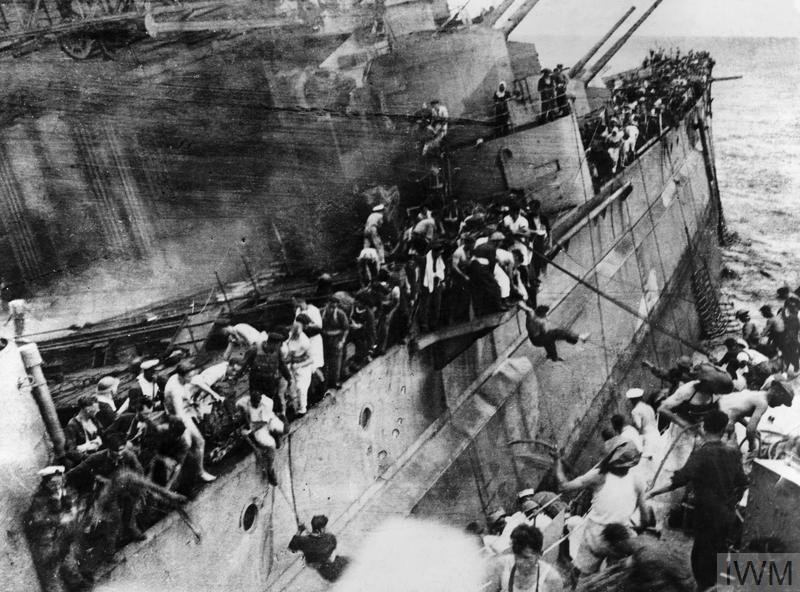
10 December 1941: Force Z arrives off Kuantan at 0800 hours only to find that no enemy forces are landing there. Shortly after 1100 hours, Force Z is attacked by a series of waves of Japanese aircraft belonging to the 22nd Air Flotilla based in Indo-China. During the first attack, at 1118 hours, by 9 Mitsubishi G3M2 “Nell” high level bombers flying at 10,000 feet, the Repulse is hit by one bomb on the port hangar but no serious damage is caused. At 1144 hours, 9 Mitsubishi G4M1 “Betty” torpedo bombers attack the Prince of Wales that is hit by one Type 91 torpedo on the port side putting both port shafts out of action and causing serious damage aft. The ship takes a 11º list to port and speed drops to 15 knots. At 1156, torpedo bombers attack the Repulse but the ship succesfully avoids the enemy torpedoes. At 1210, PoW hoists the “not under control” signal. At 1222, the Prince of Wales is attacked again by another squadron of torpedo bombers that obtain 3 more hits on the starboard side further reducing the speed of the battleship to 8 knots. At this time, Repulse closes to assist the Prince of Wales, but at 1225 the battlecruiser is hit by one torpedo jamming her rudder, followed by 3 more hits sealing the ship’s fate. At 1233, the Repulse rolls over to port and sinks with the loss of 513 men. At 1305, destroyer Express comes alongside the starboard side of Prince of Wales to rescue the crew and remains there until the very last moment. The Prince of Wales finally sinks at 1320 hours with the loss of 327 men including Admiral Phillips and Captain Leach. The Japanese lose 3 aircraft.
The wreck of the Prince of Wales rests at about 60 miles to the east of the Malay Peninsula coast. It lies upside down at a depth of 68 meters in position 3º 33′ 36″ North, 104º 28′ 42″ East.
RN Naval Writer Francis Herbert Robert Adams
One of those lost here was RN Naval Writer Francis Herbert Robert Adams. The role of ‘Writer’ in the Royal Navy was an important one, covering financial, legal, administrative and personnel matters onboard – unglamorous but essential work, especially on such a huge ship as the HMS Prince of Wales. Francis would have been an ideal serviceman in this role – before the war he is recorded as being a clerk in a naval engineering company.
He had been born on 15th January 1912 in East Ham, the son of Herbert George Forsey Adams (a railway clerk) and Louisa Adams (nee Reid) – they’d married in East Ham in 1911.
By the mid 1930s the family had moved to Brampton road in Bexleyheath, although it appears that Francis still held links with the East End – in September 1939 as war was breaking out, he married Hilda Ney in East Ham. Francis probably left for the Royal Navy soon afterwards.
Francis’s Probate records from 1941 state Effects £867 3s to Hilda Adams, widow, of 195 Brampton Road. (Hilda later remarried, in 1951, and had one son).
Francis’s parents, Herbert and Maud, later retired to the Cornish coast, gazing out – possibly – over the sea and thinking of their long lost son, lost in another far distant sea?…
Today you can see Francis Adams’ name on the Chatham Royal Naval Memorial
Chatham Naval Memorial
“After the First World War, an appropriate way had to be found of commemorating those members of the Royal Navy who had no known grave, the majority of deaths having occurred at sea where no permanent memorial could be provided.
An Admiralty committee recommended that the three manning ports in Great Britain – Chatham, Plymouth and Portsmouth – should each have an identical memorial of unmistakable naval form, an obelisk, which would serve as a leading mark for shipping. The memorials were designed by Sir Robert Lorimer, who had already carried out a considerable amount of work for the Commission, with sculpture by Henry Poole. The Chatham Naval Memorial was unveiled by the Prince of Wales (the future King Edward VIII) on 26 April 1924.
After the Second World War it was decided that the naval memorials should be extended to provide space for commemorating the naval dead without graves of that war, but since the three sites were dissimilar, a different architectural treatment was required for each. The architect for the Second World War extension at Chatham was Sir Edward Maufe (who also designed the Air Forces memorial at Runnymede, and was a one-time resident of Bexleyheath’s Red House) and the additional sculpture was by Charles Wheeler and William McMillan. The Extension was unveiled by the Duke of Edinburgh on 15 October 1952.
Chatham Naval Memorial commemorates 8,517 sailors of the First World War and 10,098 of the Second World War”
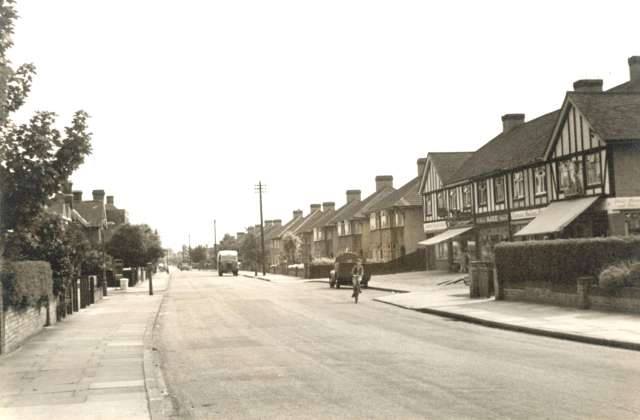
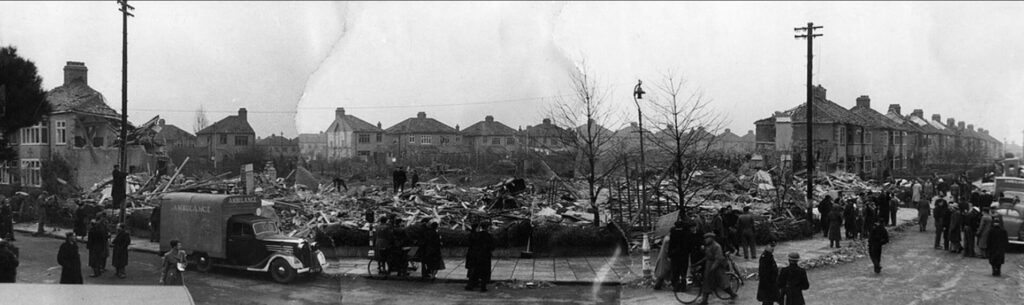
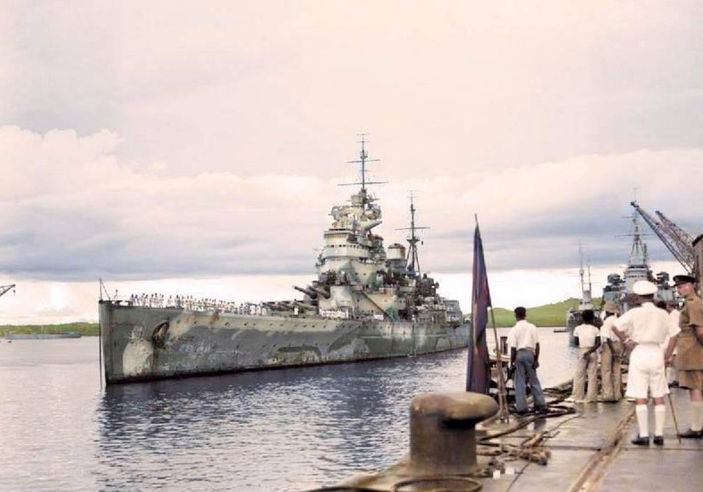
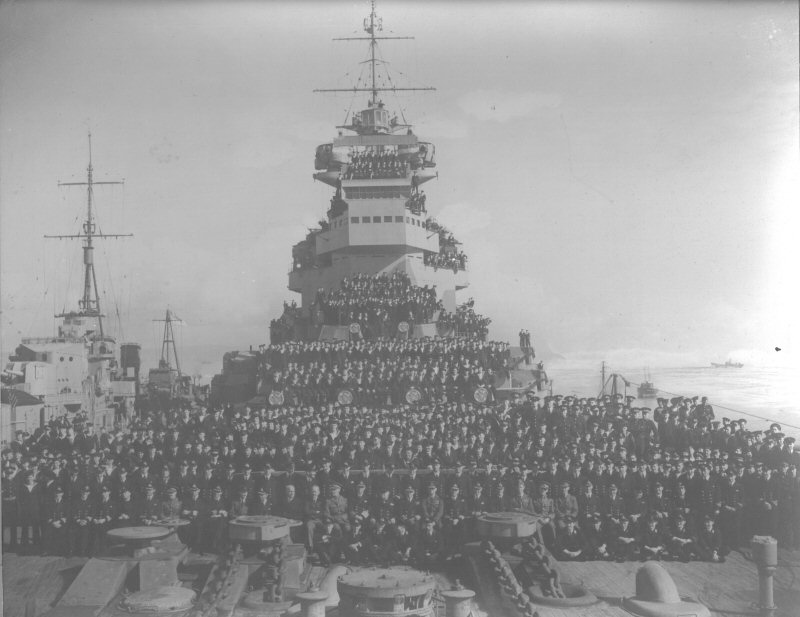
Our images show Brampton Road, as Francis and Hilda may have known it (and Brampton Road, bombed in 1944) – and also some images of the HMS Prince of Wales and its crew, including an IWM photo of crewmen abandoning ship – sadly, Francis Adams was not among them…
…………………………………………………….
If anyone is able to add any extra information, provide more family details, or suggest any corrections, please let us know – also, if anyone has any more photos of this individual listed on our memorials, please get in touch. Thank you.
Commemorated
- St. Michael’s East Wickham Church Memorial Tablet
- Chatham Naval Memorial
Links
This story has been researched by volunteers. We have taken every effort to ensure its accuracy. If you are related to Francis Herbert Robert Adams, or if you have any further information, please do get in touch.