


Death: Believed to have been on SS Khedive Ismail torpedoed by Japanese submarine
Address / Local links: 59 Lynmere Road
Family / Relatives: Son of John Edwin and Eliza Hilda Brackell
Other Information: http://www.roll-of-honour.com/Ships/SSKhediveIsmail.html
William Andrew Brackell was born on the 11th December 1924 in Greenwich, the son of John Edwin, a WW1 veteran, and Eliza Hilda Brackell (nee Phillips). They had married in Limehouse in 1921, and John’s trade was listed as ‘automatic motor repairer’. William was one of 5 children, with 3 brothers and a sister.
By the 1930s, the family had moved to Welling, and the 1939 Register lists them as living at 59 Lynmere Road, with John’s trade given as, it appears, a ‘capstan lathe hand’.
Very little else is known so far about the short life of William (who died just aged 19), but much more is known about the tragic circumstances of his death, lost off the coast of the Maldives in the far distant ocean after becoming a Stoker in the Royal Navy…
He was registered at HMS Lanka, a Shore Based Establishment in Colombo, Ceylon (modern-day Sri Lanka) but he was working on a huge WW2 troopship, the SS Khedive Ismail as it set sail from Kenya bound for Colombo in early 1944…
SS Khedive Ismail
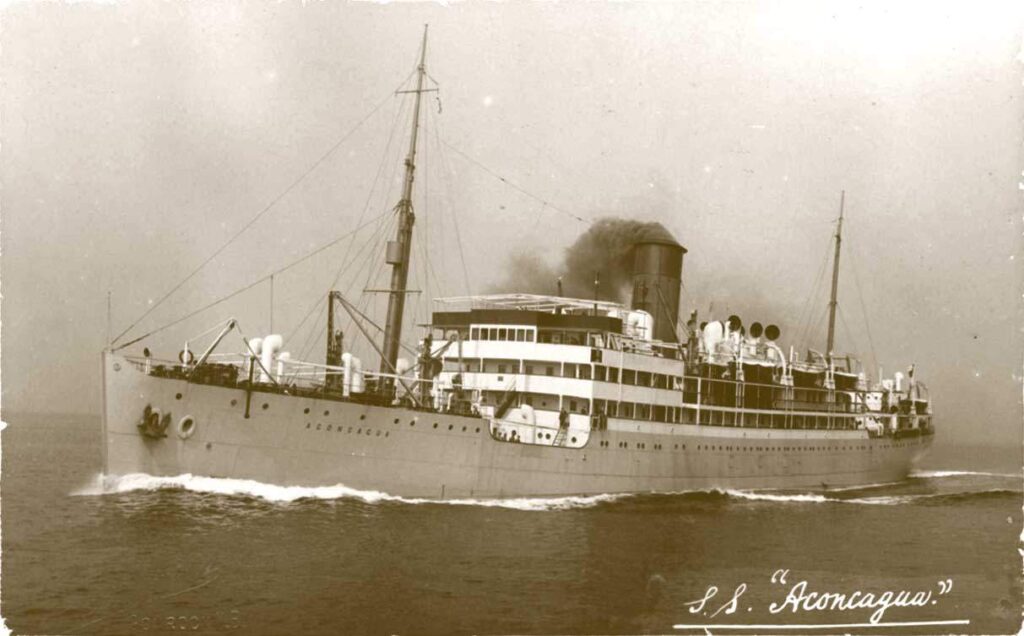
“The steamship Khedive Ismail (formerly the SS Aconcagua) was a converted steamer, originally built in Greenock in 1922; subsequently taken on by Egyptian owners (hence its new name), it was requisitioned as a British troop ship in 1940.
On 5 February 1944 Khedive Ismail left Mombasa bound for Colombo carrying 1,324 passengers including 996 members of the East African Artillery’s 301st Field Regiment, 271 Royal Navy personnel, 19 WRNS, 53 nursing sisters and their matron, nine members of the First Aid Nursing Yeomanry and a war correspondent, Kenneth Gandar-Dower. She was part of Convoy KR 8 and it was her fifth convoy on that route. The convoy was escorted by the heavy cruiser HMS Hawkins and destroyers HMS Paladin and HMS Petard. Khedive Ismail was carrying the Convoy Commodore.
Early in the afternoon of Saturday 12 February, after a week at sea, KR 8 was in the One and a Half Degree Channel south-west of the Maldives. After lunch many of the passengers were below watching an ENSA concert, while others sunbathed on deck.
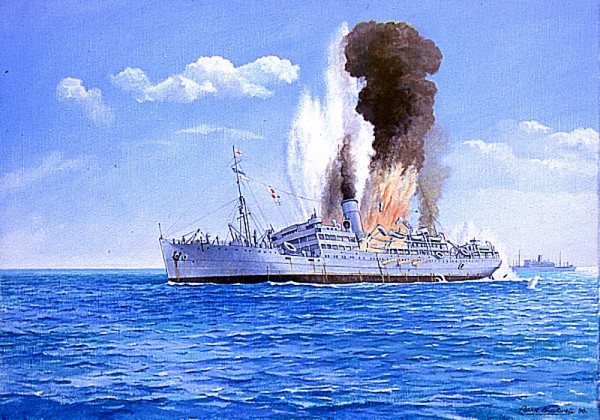
At 1430 hrs the Japanese submarine I-27 had taken position off Khedive Ismail’s port side to attack. A lookout sighted I-27’s periscope and raised the alarm; Khedive Ismail’s DEMS gunners opened fire on the submarine. At the same time I-27’s commander, Cdr Toshiaki Fukumura, fired a spread of four torpedoes, two of which hit Khedive Ismail.
The troop ship’s stern was engulfed in flame and smoke and she sank in three minutes. As the convoy’s merchant ships scattered for safety, Paladin lowered boats to rescue survivors and Petard released depth charges. The troop ship had sunk too quickly to launch any lifeboats, but her Carley floats floated free and some survivors were able to board them.
After three patterned releases I-27 was forced to the surface. The two destroyers engaged her with their 4-inch (100 mm) QF Mk 5 main guns and Paladin moved to ram her, but as a Type B1 submarine, she was considerably larger than the destroyer so Petard signalled Paladin to abort the manoeuvre. Paladin therefore took avoiding action but too late, and I-27’s hydroplane tore a 15-foot (4.6 m) gash in Paladin’s hull.
I-27 submerged again and took refuge beneath the survivors. The destruction of a submarine that might sink more ships took precedence over the lives of survivors, so with Paladin out of action Petard resumed the attack with first depth charges, then 4-inch shellfire and finally 21-inch (530 mm) Mk IX torpedoes. The depth charge fuses had to be set to detonate at the most shallow depth, and they killed or wounded many people who had survived the initial sinking. The seventh torpedo finally destroyed I-27, sinking her with all hands. The battle had lasted two and a half hours.
Of 1,511 people aboard Khedive Ismail, only 208 men and 6 women survived the sinking and subsequent battle. 1,220 men and 77 women were killed. The sinking was the third largest loss of life from Allied shipping in World War II and the largest loss of servicewomen in the history of the Commonwealth of Nations”…Among those thousands lost was our own young William Brackell.
We have been told by William’s family that travelling on another ship in the same convoy was William’s younger brother, Jack (the Navy didn’t put siblings on the same ship). It must have been heartbreaking for him to witness the sinking of the Khedive Ismail and the loss of his older brother.
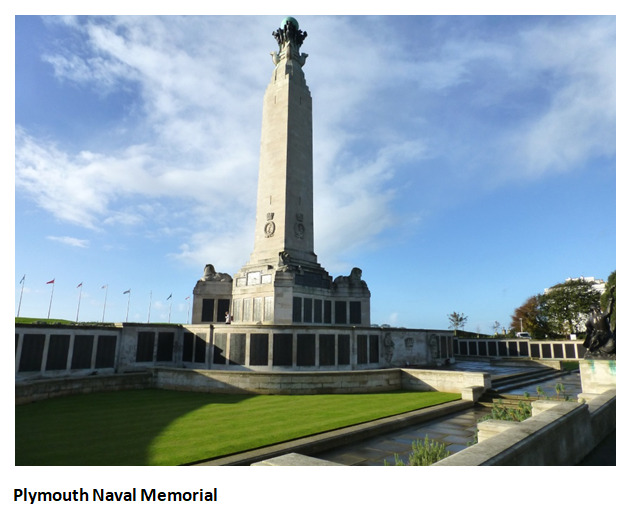
The Plymouth naval memorial
Today, you can see his name on the Plymouth naval memorial, one of the city’s proudest landmarks, situated centrally on The Hoe which looks directly out towards Plymouth Sound and the sea…
“After the First World War, an appropriate way had to be found of commemorating those members of the Royal Navy who had no known grave, the majority of deaths having occurred at sea where no permanent memorial could be provided.
An Admiralty committee recommended that the three manning ports in Great Britain – Chatham, Plymouth and Portsmouth – should each have an identical memorial of unmistakable naval form, an obelisk, which would serve as a leading mark for shipping. The memorials were designed by Sir Robert Lorimer, who had already carried out a considerable amount of work for the Commission, with sculpture by Henry Poole. The Plymouth Naval Memorial was unveiled by HRH Prince George on 29 July 1924.
After the Second World War it was decided that the naval memorials should be extended to provide space for commemorating the naval dead without graves of that war, but since the three sites were dissimilar, a different architectural treatment was required for each. The architect for the Second World War extension at Plymouth was Sir Edward Maufe (who also designed the Air Forces memorial at Runnymede) and the additional sculpture was by Charles Wheeler and William McMillan. The Extension was unveiled by HRH Princess Margaret on 20 May 1954. A further unveiling took place on 11 November 1956, when panels 101 to 103 honouring those who died on shore, but who had no known grave, were unveiled by Admiral Sir Mark Pizey.
In addition to commemorating seamen of the Royal Navy who sailed from Plymouth, the First World War panels also bears the names of sailors from Australia and South Africa. The governments of the other Commonwealth nations chose to commemorate their dead elsewhere, for the most part on memorials in their home ports. After the Second World War, Canada and New Zealand again chose commemoration at home, but the memorial at Plymouth commemorates sailors from all other parts of the Commonwealth.
Plymouth Naval Memorial commemorates 7,251 sailors of the First World War and 15,933 of the Second World War.”
…………………………………………………….
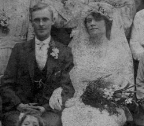
Pictured are William’s parents on their wedding day, and his ship, the doomed SS Khedive Ismail
If anyone is able to add any extra information, provide more family details, or suggest any corrections, please let us know – also, if anyone has any more photos of this individual listed on our memorials, please get in touch. Thank you.
Commemorated
- Welling War Memorial
- Plymouth Naval Memorial
Links
This story has been researched by volunteers. We have taken every effort to ensure its accuracy. If you are related to William Andrew Brackell, or if you have any further information, please do get in touch.