


George Henry CASE was born 26th June 1874 in the district of Dartford. His parents were George, an Agriculture Labourer and Elizabeth (nee Baldry). He had 2 brothers and 2 sisters, Elizabeth (born abt 1872), James (born abt 1879), Alice (born abt 1885) and William (born abt 1891). His first known address is 109 Albert Place, Welling.
1890 – Elizabeth the eldest sister of George marries Richard, Henry Ricketts. Their oldest son George, William died in 1917 and his name is on both the East Wickham and Welling Memorial and the Welling Memorial. This means that George Henry Case and George William Ricketts are Uncle and Nephew.
1891 – George, aged 16yrs is employed as an Agriculture Labourer and the family have moved to Jackman Cottages, Bellegrove, Welling.
8th June 1894 – George has now dropped his first name and, known simply as Henry Case, signs up as a 2nd class stoker at the age of 19 with the Royal Navy for a period of 12 years. He is described as 5 ft 4″ tall, with dark brown hair, light blue eyes and a fresh complexion. On his left forearm he sports an anchor and crossed flags tattoo.
8th June 1894 – April 1996 – George learns his profession on shore based training ships HMS Pembroke (at Chatham) and HMS Wildfire (at Sheerness). His character is described throughout as ‘very good’.
April 1896 – August 1896 – George serves on HMS Sappho, possibly in the colonies. He spends August back on training ship HMS Pembroke II.
August 1896 – November 1899 – George transfers to HMS Hood. He starts off well, his character still described as ‘very good’, then in 1898 it drops to ‘good’. However in 1899 he gets himself into trouble, spending periods of 14 days, 3 days and 10 days in the cells, followed by 54 days imprisonment.
1900 – His conduct is back to ‘very good’ and he serves on HMS St George, HMS Hood, HMS Pembroke and HMS Scylla.
1901 – He marries Sarah Ann Noble in the Spring.
George’s family is now living in Blaxland Cottages, Bellegrove and the census shows us that George’s father has become a Furnace Stoker and his brother James is working at the Royal Arsenal as a General Labourer.
1901 -1911 George is assigned to the Royal Fleet Reserves at Chatham for 5 years. At the end of his 12 year service, in 1906, he re-enrolls for a further 5 years and then again in August 1910, to serve until 1916. However soon after his last re-enrollement her buys his way out of the Royal Navy for the sum of £12.
1911 – The couple are living at 4, Albert Grove West, Bellegrove and George is now employed as a Platelayer for the Railways. They have 5 children, George, Reuben, aged 9, Clara, Elizabeth aged 7, James, William aged 5, Cyril, Henry aged 3 and Henry, Frederick aged 1.
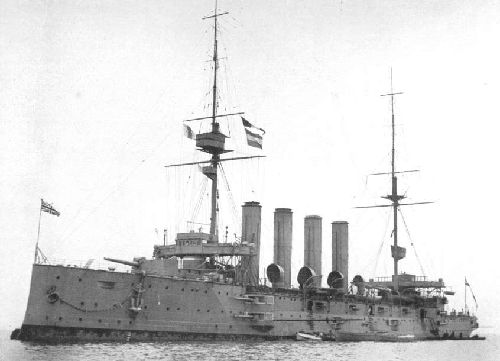
2nd August 1914 – George was called up to serve in the war. He was fatefully assigned to HMS Aboukir, a Cressy Class Armoured Cruiser. It had a displacement of 12,000 tons with two 9.2inch guns (bow & Stern), twelve 6 inch quick firers in a central battery and many more small quick-firers and machine guns. Speed: 21 knots. Launched 16th May 1900.
His ship was initially part of the 7th Cruiser Squadron ( Cruiser Force C ) in the area of the North Sea known as the Broad Fourteens. The Broad Fourteens is an area of the southern North Sea and is a shallow area. It is located off the coast of the Netherlands and south of Dogger Bank. The other three cruisers were HMS Eurylus, Cressy and Hogue.
There was opposition to this patrol from many senior officers including Admiral Jellico and Commodores Keyes and Tyrwhitt, on the grounds that the ships were very vulnerable to a raid by modern German surface ships and the patrol was nicknamed the ‘live bait squadron’. Many of the men serving on these ships were reservists. The Admiralty upheld their decision to maintain this patrol on the grounds that destroyers were unable to patrol the area owing to frequent bad weather and that there were insufficient modern light cruisers available.
George could well have seen his first action at the Battle of Heligoland Bight as his ship, HMS Akoukir was, on 28th August 1914, part of the covering force at this battle.
His ship together with her sister ships, were assigned to patrol the North Sea. This was in support of a force of British destroyers, which blocked the eastern end of the English Channel from German warships attempting to attack the supply route between England and France. In the day’s fighting, which at the end the British forces were victorious, the Royal Navy sunk three German light cruisers and one destroyer while damaging three other light cruisers. The battle cost to the German’s was 712 killed, 149 wounded and 336 captured, whilst to the British 35 were killed and 55 wounded.
Whilst the battle did not involve either side’s battleships, it did have a great significant impact on the war. Kaiser Wilheim ordered his Navy to ‘hold itself back and avoid actions which can lead to greater losses’. He also stipulated that his permission was required before the fleet could sortie, effectively confining it to port.
20 September 1914 – In the early hours the Cruisers HMS Aboukir, Cressy, Euryalus and Hogue left port to go on patrol in the North Sea. HMS Euryalus had technical problems and returned to port. At around 6a.m. on the 22nd September 1914 the three remaining Cruisers were steaming at 10 knots in a line ahead (not zigzagging) when they were spotted by the German submarine U9 which was under the command of Commander Otto Weddigen. Although patrols were supposed to maintain 12-13 knots and zigzag, the old cruisers were unable to sustain that speed and the zigzagging was widely ignored as there had been no recent sightings of submarines in the area. Weddigen ordered his submarine to submerge and closed the range on the unsuspecting ships. HMS Akoubir was the first to be hit, the torpedo broke the back of the ship and she sank within 20 minutes with the loss of 527 men.
The captains of the Cressy and the Hogue thought that the Aboukir had struck a floating mine and came forward to assist her and to pick up survivors. At this point, Weddigen fired two torpedoes into the Hogue, mortally wounding that ship. As the Hogue sank, the Captain of the Cressy realised that the squadron was being attacked by a submarine and tried to flee. However, Weddigen fired two more torpedoes into the Cressy and sank her as well. 837 men were rescued but 1,459 men were killed in total.
The bulk of the blame at the subsequent Court of Enquiry was directed at the Admiralty “for persisting with a patrol that was dangerous and of limited value against the advice of senior sea-going officers”. The German Commander of the submarine, Kapitanleutnant Otto Weddigen, reputedly reflected that “It was one of the most notable submarine actions of all time”.
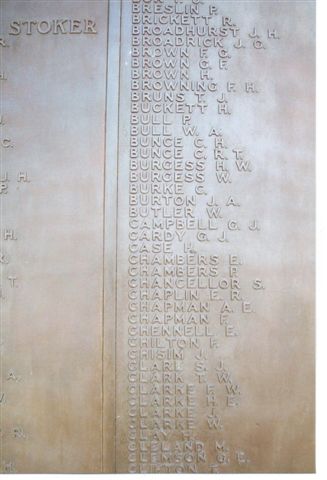
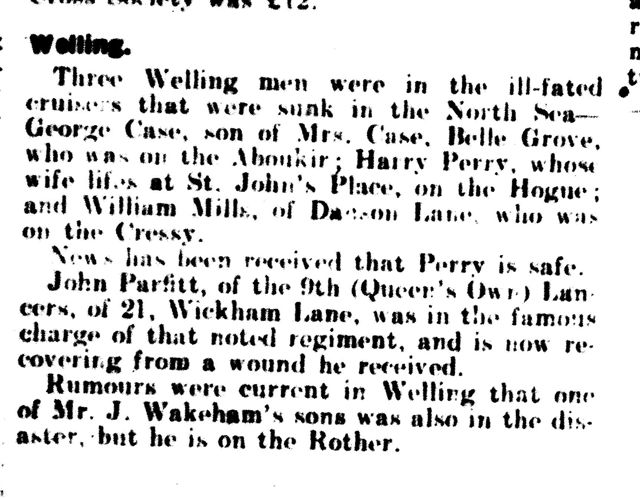
George died on the 22nd September 1914, aged 40, as a direct result of enemy action, his body was not recovered. He is remembered on the Memorials at St Michael’s Church, East Wickham and the Welling Memorial at St John’s Church, Danson Lane, also on the Chatham Naval Memorial.



Commemorated
Links
This story has been researched by volunteers. We have taken every effort to ensure its accuracy. If you are related to George Henry Case, or if you have any further information, please do get in touch.