


Vincent Henry Collins was born between July and September 1883 in Croydon to William and Louise Marie Collins, both born in London and married in around 1876. Vincent was the youngest of three boys, the eldest, Noel Hamilton, was seven years older and Arnold was five years older. Vincent was christened in Croydon when he was around a year old, and spent his early life there, living in Essex Grove, Upper Norwood. Vincent’s Grandmother Sarah Ravey, born in Ireland, also lived with the family (Sarah appears to be William’s mother, but it has not been possible to establish why she had a different surname). The family also employed a servant.
Little is known about Vincent’s father William and it is unclear what his exact occupation was. In 1881 he was working as a wine merchant, but he is not listed on any census records after Vincent’s birth. In July 1904, the marriage certificate from Noel’s wedding states his father’s occupation as being an engineer, although sadly William had died by that point.
The family moved to Lambeth in the early 1900s and lived at Newlands House on Salters Hill. The death of Vincent’s father could have been the reason for the move. However, the family appear to have been financially secure as both Vincent’s mother and grandmother were living on their own means and the household continued to employ a servant. Vincent’s grandmother died in Croydon in October 1904, at the age of around 85.
At the age of 17, Vincent was working as a bank clerk, as was his brother Arnold, whilst Noel worked as an insurance clerk. By 1911 Noel was living in Park View Road, Welling, with his wife Beatrice, their son Fred Vincent Hamilton, and a servant. Their mother and brother Arnold (aged 32) were both living by private means in Elham, near Canterbury, with a servant. However, little other information is available about Vincent’s life from the early 1900s up to the outbreak of war. The outbound passenger list of the Braemar Castle, bound for South Africa, in March 1905 lists a V H Collins travelling in cabin class. Vincent’s medal roll card for the war records that he initially served as a Lance Corporal with the 2nd Rhodesia Regiment, it is possible he could have gone from South Africa to Rhodesia (now Zimbabwe) at some stage prior to the war. However, the regiment was trained at Salisbury, so it is also possible that Vincent never went to Africa and joined the regiment whilst it was in the UK instead.
At the outbreak of the war, the 1st and 2nd Rhodesia Regiments were formed from the Southern Rhodesia Volunteers (SRV) and civilian volunteers. The unit left Salisbury on 8th March 1915 after eight weeks of training, moving east to the port of Beira in Portuguese Mozambique, from where it sailed to Mombasa in British Kenya, on German East Africa’s north-eastern flank. Travelling aboard the SS Umzumbi, the unit disembarked in Kenya less than a week after leaving Salisbury. It was immediately sent inland to the operational area around Mount Kilimanjaro, where it set up camp. However, the unit was forced to return to Rhodesia in 1917, due to the high ratio of casualties suffered in action in German East Africa. It was then disbanded in Salisbury for lack of reinforcements from Rhodesia’s small male white population at that time.
At least six months before the 2nd Rhodesia Regiment was disbanded, Vincent was appointed a Lieutenant with the Indian Army Reserve of Officers, attending the 102nd King Edward’s Own Grenadiers, on the 24th June 1916. It is not known when or why he moved from 2nd Rhodesia Regiment. At the start of the war the regiment was stationed at Muscat, Oman and served in the Mesopotamia Campaign (now Iraq) with the 14th Indian Division taking part in the Second Battle of Kut (1916-17) and the Fall of Baghdad (March 1917).
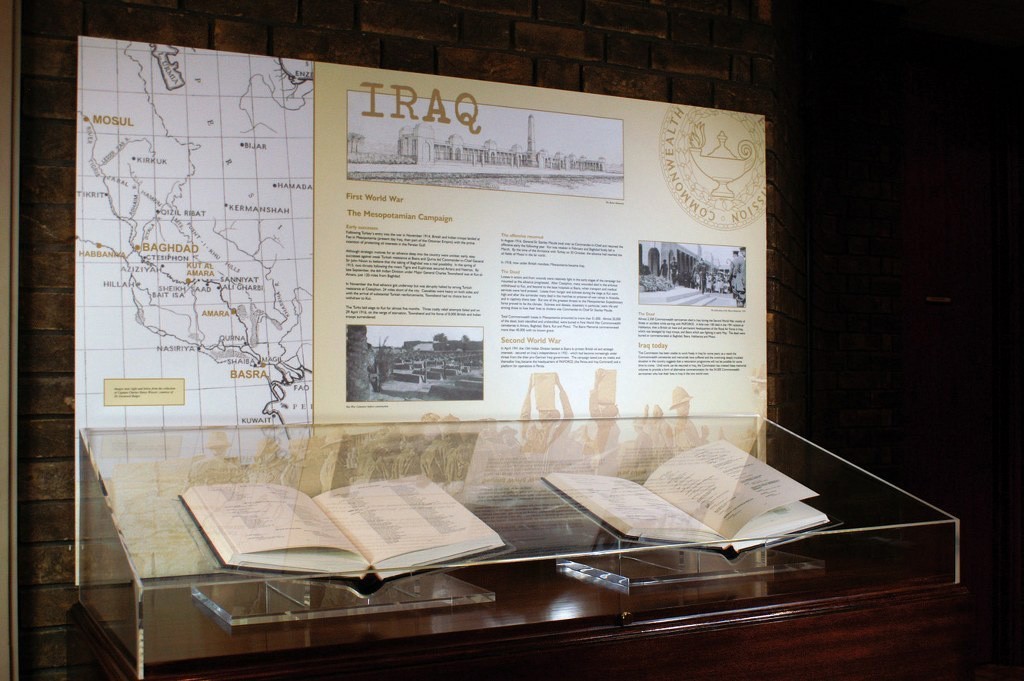
Vincent passed away on the 12th February 1917; it is not known how he died. He is remembered at the Amara War Cemetery in Iraq. Amara is a town on the left bank of the Tigris which was occupied by the Mesopotamian Expeditionary Force on 3rd June 1915 and it immediately became a hospital centre. The accommodation for medical units on both banks of the Tigris was greatly increased during 1916 and in April 1917, seven general hospitals and some smaller units were stationed there. Amara War Cemetery contains 4,621 burials of the First World War, more than 3,000 of which were brought into the cemetery after the Armistice. 925 of the graves are unidentified.
Vincent was added to the East Wickham memorial as his brother Noel went to St. Michael’s Church. Noel had moved to The Gables on Belle Grove Road, Welling by 1915 and was still living there in 1920.

Commemorated
Links
This story has been researched by volunteers. We have taken every effort to ensure its accuracy. If you are related to Vincent Henry Collins, or if you have any further information, please do get in touch.