


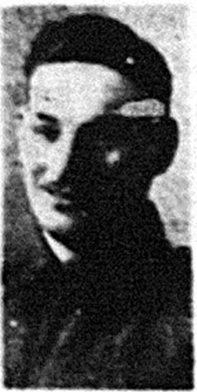
Died: Killed in action at the St Nazaire raid
Address / Local links: 6 Lovel Avenue, Welling
Family / Relatives: Son of Ernest Albert Grose, and of Agnes Grose, of Welling
Local Papers / Websites: BHO 17th August 1945
William was born on 3rd June 1918, in Welling, not long after his family had moved into the area from Hackney, where all his siblings were born. His father was born in Devon and his mother in Old Ford, Essex.
By 1921 the family were living at 213 Kirklea Street, Welling, one of the East Wickham hutments built during the First World War, mainly to house the large influx of workers at the Royal Arsenal Woolwich. William was by then 4 years old and had three older sisters – Lilian (10), Violet (8) and May (6) – and his cousin, Albert Bell (6) was also staying with them. William’s father Ernest Albert Grose was 45 years old and working as a butcher, and his mother Agnes was 41 and looking after the home and family.
William went to Foster’s School in Welling, before leaving to work as a carpenter’s joiner for the Messrs Stevens Brothers, who built the Stevens Estate houses in Welling.

By the time war was declared in 1939, William and his mother were living at 6 Lovel Avenue. His father had died the year before and Agnes was now working as a shopkeeper and William as a carpenter’s joiner. He had also volunteered as a special constable: the ‘Specials’ both helped the regular police to maintain law and enforce war time regulations, but also helped with civil defence and counter-invasion plans and had a key role during air raids.
William also volunteered for the Army at the outbreak of war and started his service as a guardsman with the Grenadier Guards (this was the equivalent rank to a private). He would not stay there, transferring to the elite Commandos.
The Commandos
In June 1940, Winston Churchill requested that special forces be formed “to develop a reign of terror down the enemy coast” and which would be trained to carry out raids in German-occupied Europe. This led to the birth of the Commandos, their name derived from the Boer Commandos, whose tactics were to “hit sharp and quick – then run to fight another day”. The modern-day Royal Marine Commandos, Parachute Regiment, Special Aid Service, British Army Commandos and Special Boat Service all trace their origins back to the Commandos.
There were 15 Commando units in the UK, each with a different specialism e.g. intelligence gathering and serving in the Arctic Circle. Each Commando unit was made up of around 450 men, divided into 75-man troops, further divided into 15-man sections, each man also retaining their original regiment.
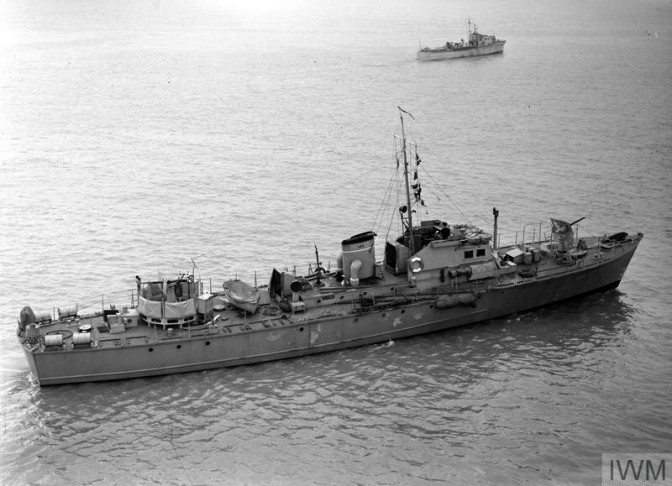
It appears William trained as a paratrooper and at some point joined No.2 Unit, which had originally been intended as a parachute unit (and it became the 1st Parachute Batallion) so maybe he was involved there from an early part of the war. The first two actions of No.2 Commando were in Norway; to destroy fish-oil production and stores which the Germans used in the manufacture of high explosives and then to destroy a German held power plant, alongside the aim of diverting German troops to Norway away from other theatres of war. We don’t know if William was involved in either of these raids.
St Nazaire Raid – Operation Chariot
William’s fate was sealed in the early months of 1942, when Winston Churchill approved one of the most daring missions of the Second World War; Operation Chariot, the St Nazaire Raid, ‘the greatest raid of all’. The aim of the raid was to destroy the dry dock at St Nazaire, which was the only dock capable of servicing the powerful German battleship, Tirpitz, stationed at Trondheim on the Norweigian coast in January 1942. At over 50,000 tons, Tirpitz was heavily armored and could outgun or outrun any other warship so was an enormous threat to the allies in the North Atlantic.
Four separate attempts to bomb the Tirpitz had failed, with the loss of 12 aircraft. Instead a plan was put into place to destroy the dry dock at St Nazaire which meant, if she were damaged, she would need to travel to home waters, exposing her to attack by British forces in the English Channel or the North Sea.(Tirpitz was later destroyed on 12th November 1944 by a squadron of 32 British Lancaster bombers. It capsized and sank in only 11 minutes with the loss of between 950 and 1,200 lives)
Preparations and planning
Operation Chariot was a combined operation undertaken by Royal Navy and Commando units, tasked with demolition, assaulting the harbour gun positions and providing covering fire for the demolition parties. No. 2 Commando was the leading commando unit in the raid, providing 100 men.
The sailors and Commandos undertook specialist training for weeks, including studying blueprints of a near identical dock. Before their training was completed the team tasked with exploding vital pump systems could complete their mission blindfolded.
Obsolete WW1 destroyer HMS Campbeltown was stripped of her interiors and filled with high explosives in her bow with the plan of ramming the outer gate of the dock to become stuck, after which she would be detonated, thus destroying the gate. The inner gate would then be torpedoed and the troops and crew would then destroy as many dockyard targets as they could, under the cover of an air raid. The plan was for a quick evacuation on motor launches.
The Raid
At 3pm on the 26th of March, a convoy 18 vessels left Falmouth in Cornwall, bound for St Nazaire. In the early hours of the 28th March, the convoy neared the port. However, German defenses were on full alert: an RAF air raid on the town, intended as a diversion, had been thwarted due to low cloud and had instead alerted the Germans.
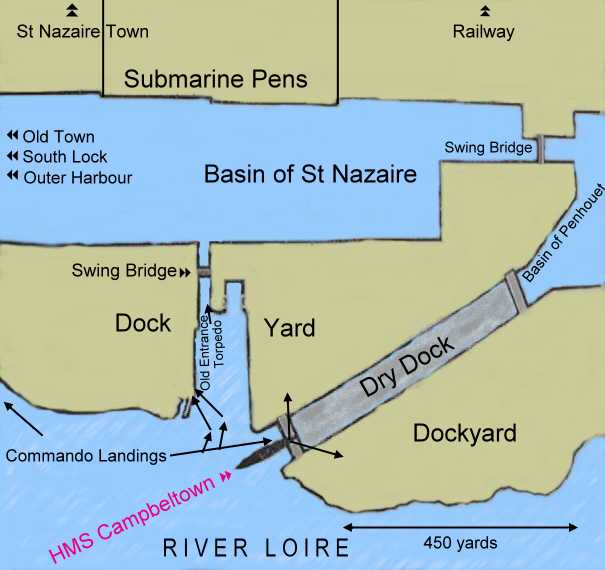
As the flotilla progressed, German suspicions increased, and the vessels were challenged. The British had obtained German secret codes and replied they were friendly vessels coming in for repairs. The ships were also flying German flags to further their disguise. But the Germans soon started firing, the British immediately responding with fire and the German flags were quickly all replaced with the British battle standards. As the flotilla approached, intense shelling and gun fire killed or wounded half the men aboard the motor launchers.

At 0134 hours, HMS Campbeltown was successfully driven at speed into the dock gates. The Commando teams on board scrambled ashore, many of them wounded. Only two of the motor launchers succeeded in landing all their Commandos. Despite being heavily outnumbered and with intense fighting, they managed to disable strategic equipment and operations. It had been planned to evacuate them on motor launches, but with many of the motor launchers sunk or disabled, and with heavy attack from the Germans meaning the remaining motor launchers could not approach, the Commandos were stranded. Heavy fighting continued throughout the night until dawn arrived, when the surviving commandos went into hiding around St. Nazaire. However, they were exhausted, many were wounded, supplies and ammunition were depleted and there was no escape possible. It was decided to surrender (although five commandos did manage to escape, on foot, through Spain to British held Gibraltar).
HMS Campbeltown had been timed to explode at 0900. With the town and harbour secure, the Germans had started to relax. However, late morning, the ship exploded, killing hundreds of Germans and later that day, two time-delay torpedoes exploded beside the gates to the harbour away from the dry dock and near the U-boat pens. The damage to the dock was so severe, it was not repaired until several years after the war.
The cost
The mission was a success. However, this came at a huge cost:
* 611 Royal Navy and Commandos took part in the raid. 169 died and 265 were captured, of which half were injured.
* 18 coastal craft set out from Falmouth. Only 4 returned. This included 16 motor launchers, vital for the evacuation of the troops and commandos. Only 3 returned.
89 medals were awarded, including 5 Victoria Crosses were awarded, more than any other WWII operation.
William’s premonition of his death
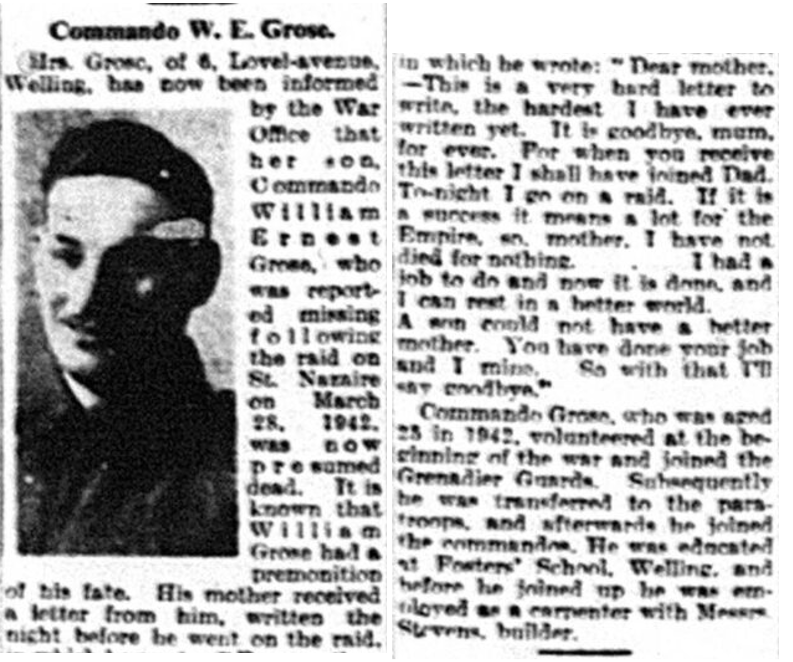
The night before the raid, William wrote to his mother:
“Dear mother. – This is a very hard letter to write, the hardest I have ever written yet. It is goodbye, mum, for ever. For when you receive this letter I shall have joined Dad. Tonight I go on a raid. If it is a success it means a lot for the Empire, so, mother, I have not died for nothing. I had a job to do and now it is done and I can rest in a better world. A son could not have a better mother. You have done your job and I mine. So with that I say goodbye.”
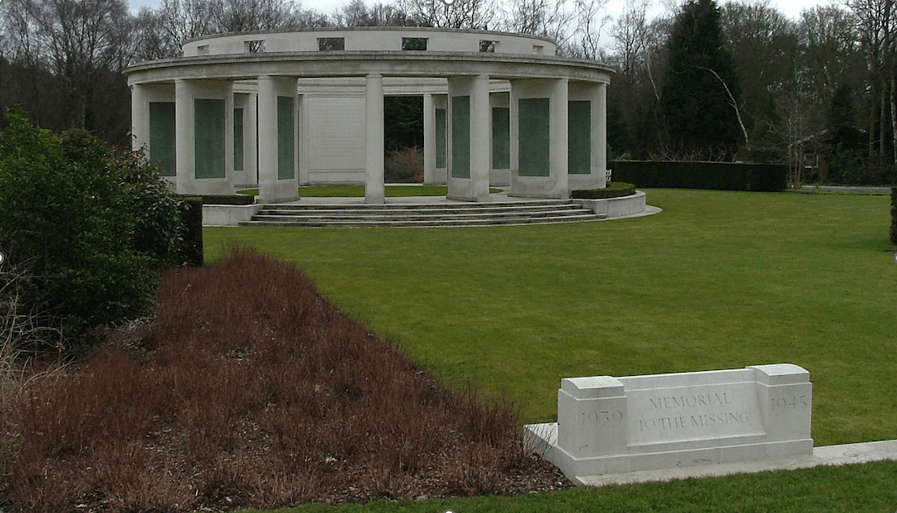
William was reported missing on the day of the raid. After the war ended, it was reported in the local paper that he was presumed dead, and we can only assume that his mother held out hope that he had been taken a prisoner of war. He is commemorated on the Brookwood 1939-1945 Memorial alongside nearly 3,500 men and women of the land forces of the Commonwealth who died during the Second World War and have no known grave, the circumstances of their death being such that they could not appropriately be commemorated on any of the campaign memorials in the various theatres of war and this included those who died in the raid at St Nazaire.
If anyone can add any extra information, provide more family details, or suggest any corrections, please let us know – also, if anyone has any more photos of this individual listed on our memorials,
please get in touch. Thank you.
Commemorated
- St. Michael’s East Wickham Church Memorial Tablet
- Brookwood 1939 - 1945 Memorial
Links
This story has been researched by volunteers. We have taken every effort to ensure its accuracy. If you are related to William Ernest Grose, or if you have any further information, please do get in touch.