


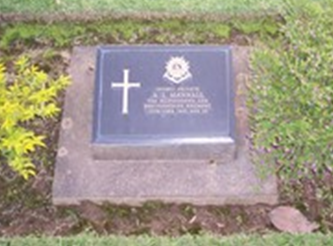
Address / Local links: 32 Lodge Lane, Welling
Family / Relatives: Son of Albert Edward and Florence Elsie Mannall. Husband of Mary R Mannall of Galashiels, Selkirkshire.
Other Information: Born Poplar. Poor Law School pupil
Records suggest that our Albert Leslie (“Bert”) Mannall died after almost a year and a half in captivity in a Japanese POW camp – he was finally laid to rest on 22 February 1946 in Kanchanaburi Cemetery in Thailand.
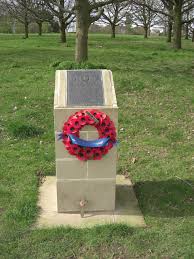
Nearer to home than that, Bert Mannall can be remembered at the POW memorial and commemorative trees in Danson Park – the bronze plaque on a yorkstone pillar unveiled on 21st November 1985 has a tablet which reads;
FAR EAST PRISONER OF WAR/ ASSOCIATION (LONDON)/ 1941 1945/ “TO KEEP GOING THE SPIRIT/ THAT KEPT US GOING”/ THESE OAK TREES ARE DEDICATED/ TO THE MEMORY OF ALL THOSE/ WHO DIED FIGHTING AGAINST JAPAN/ AND OF OUR COMRADES WHO DIED/ AS A RESULT OF THEIR CAPTIVITY/ IN THE JAPANESE PRISON CAMPS/ “THE PRICE THAT WAS PAID WE WILL/ ALWAYS REMEMBER/ EVERY DAY, EVERY MONTH, NOT JUST NOVEMBER”/ 21ST NOVEMBER 1985
Albert Leslie Mannall
Here is Bert’s story – it has been a hard one to research, and it tells of a hard family life…
He was born on 18th November 1919 in East London. He was one of seven children. His father Albert Edward Mannall (1895 – 1959) was an Iron Moulder which involved heavy work. His mother was Florence Elsie Mannall (nee Keen – 1897 – 1944).
Our Albert was baptised at Christ Church Poplar in Tower Hamlets on 14 December 1919.
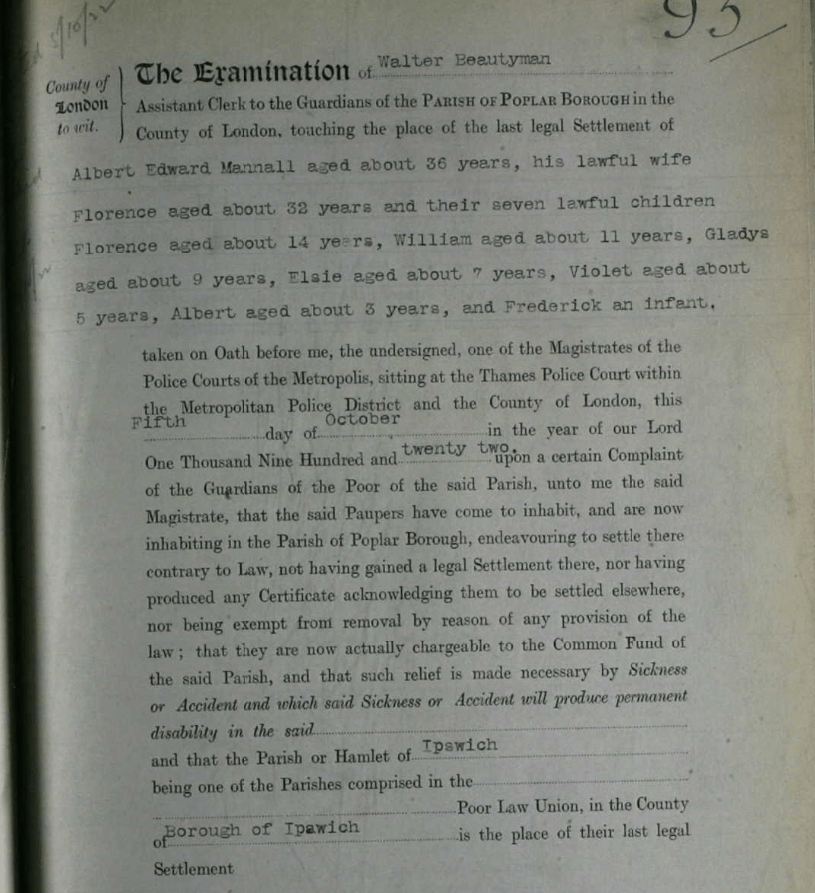
Two years later, in 1922, we find a document (pictured) from the local Poor Law authorities showing the Mannall family being ejected from their Poplar hostel and sent to Ipswich – (this included both parents and seven children)…
By the time of the 1939 Register, we find the Mannalls back in Poplar, living at 225 Manchester Road on the Isle of Dogs – Albert snr was an ‘iron moulder – heavy work’, while our Bert was a general labourer in a glass foundry – hot, hard work, no doubt…
Family records for Bert prove difficult to trace around this time – as they do for his wife – Records indicate that he married and that his wife lived at 17, Wilderhaugh St., Galashiels in Scotland in around 1942/3. It has not been possible to confirm her name for certain – we believe that her name was Romanes Paterson (known as Roma) and that she may have re-married after Bert’s death with the new surname Lawrie.
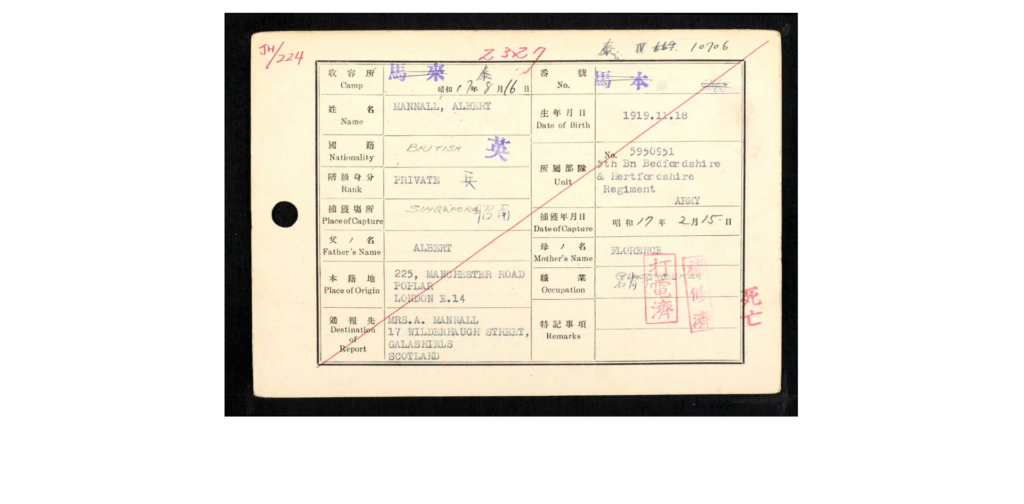
Confusingly, a Japanese camp document lists her as ‘Mrs A. Mannall’ at her address in Galashiels. (Obviously, if anyone can shed further light on this, that would be helpful).
War in the far east
With the advent of war, Bert joined the Army and served as a Private in the 5th Battalion Bedfordshire and Hertfordshire Regiment. This Battalion was sent to the Far East and initially fought in Malaya and eventually retreated to Singapore.
When Singapore surrendered on 15 February 1942 Albert was one of the more than 80,000 Allied Service men taken into captivity by the Japanese.
The Japanese planned to build a railway from Thailand to Burma and used civilian forced labour and Allied Prisoners of War to do this. Prisoner of War work and transit camps were set us at Tamarkan and Nong Pladuk. POW’s were then transported to work camps along the railway.
During World War II at least 23,289 British, 12,329 Dutch, 4,708 Australian, 482 American and 7,030 undetermined soldiers passed through the camps. Of the 61,811 prisoners deployed on both sides of the railway line 12,619 died. Of the estimated 177,700 civilian forced labourers deployed, 85,400 died.
Prisoner of War records show that Albert died of Cholera on 13 June 1943.
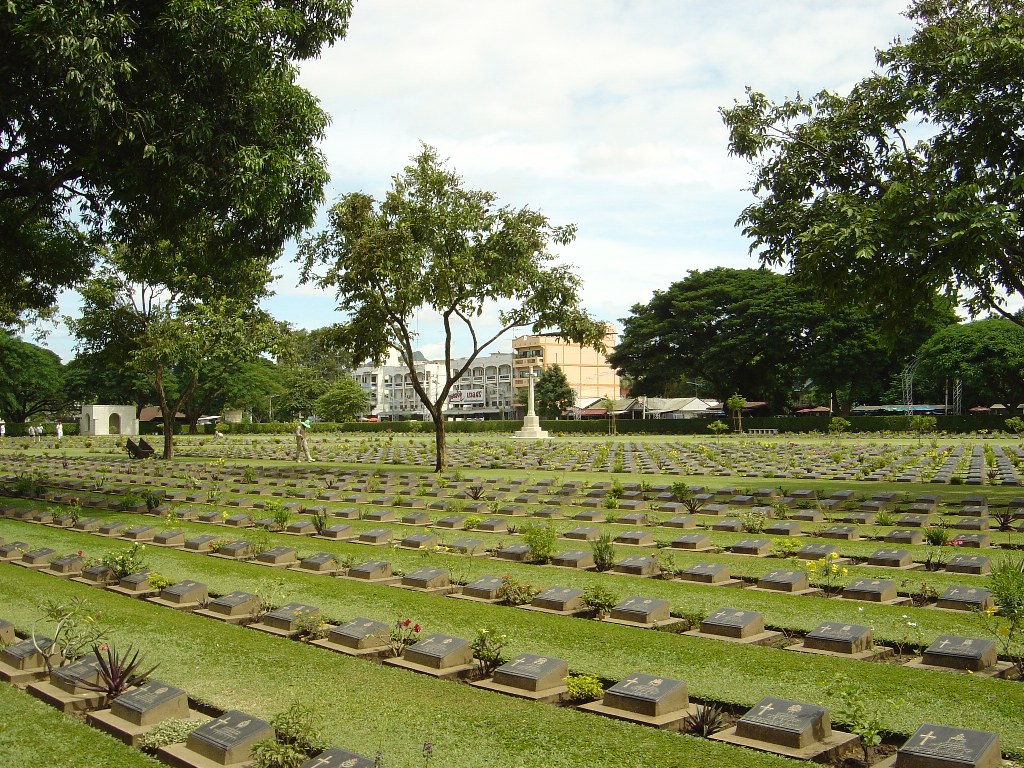
Albert was finally laid to rest on 22 February 1946 in Kanchanaburi War Cemetery (8 D. 19)
KANCHANABURI WAR CEMETERY
The town of Kanchanaburi is 129 kilometres North-West of Bangkok.
“The notorious Burma-Siam railway, built by Commonwealth, Dutch and American prisoners of war, was a Japanese project driven by the need for improved communications to support the large Japanese army in Burma. During its construction, approximately 13,000 prisoners of war died and were buried along the railway. An estimated 80,000 to 100,000 civilians also died in the course of the project, chiefly forced labour brought from Malaya and the Dutch East Indies, or conscripted in Siam (Thailand) and Burma (Myanmar).
Two labour forces, one based in Siam and the other in Burma worked from opposite ends of the line towards the centre. The Japanese aimed at completing the railway in 14 months and work began in June 1942. The two sections of the line finally met near Konkoita towards the end of October 1943 and the completed line, 424 kilometres long, was operational by December 1943.
The graves of those who died during the construction and maintenance of the Burma-Siam railway (except for the Americans, whose remains were repatriated) were transferred from camp burial grounds and isolated sites along the railway into three cemeteries at Chungkai and Kanchanaburi in Thailand and Thanbyuzayat in Myanmar.
KANCHANABURI WAR CEMETERY is only a short distance from the site of the former ‘Kanburi’, the prisoner of war base camp through which most of the prisoners passed on their way to other camps. It was created by the Army Graves Service who transferred to it all graves along the southern section of railway, from Bangkok to Nieke.
Some 300 men who died (most from a Cholera epidemic in May/June 1943) at Nieke camp were cremated and their ashes now lie in two graves in the cemetery. The names of these men are inscribed on panels in the shelter pavilion.
There are now 5,085 Commonwealth casualties of the Second World War buried or commemorated in this cemetery. There are also 1,896 Dutch war graves and 1 non-war grave.
Within the entrance building to the cemetery will be found the KANCHANABURI MEMORIAL, recording the names of 11 men of the army of undivided India buried in Muslim cemeteries in Thailand, where their graves could not be maintained.
The cemetery was designed by Colin St Clair Oakes.”
………………………………………………………………………
We think the local connection for Bert Mannall, and the reason why he’s on the memorial is linked to his mother, Florence Elsie who died in 1944 but was living at 32 Lodge Lane – she is buried at St. Michael’s churchyard in East Wickham.
Also Bert’s elder sister Elsie Lilian (Farrow) lived in Bedonwell Road until her death in 1992, so it’s probably through her that he was remembered here and named on our memorial.
Pictured, along with some POW documents, are the 1922 Poor Law file concerning the Mannalls, Manchester Road Poplar as they would have known it, the Kanchanaburi War Cemetery, and the Japanese POW memorial stone in Danson Park.
…………………………………………………….
If anyone is able to add any extra information, provide more family details, or suggest any corrections, please let us know – also, if anyone has any more photos of this individual listed on our memorials, please get in touch. Thank you.



Commemorated
- St. Michael’s East Wickham Church Memorial Tablet
- Kanchanaburi War Cemetery, Thailand
This story has been researched by volunteers. We have taken every effort to ensure its accuracy. If you are related to Albert Leslie Mannall, or if you have any further information, please do get in touch.