


Died: Killed during a bombing raid on Crete
Address / Local links: 46 Glenmore Road, Welling
Family / Relatives: Son of Harry William and Clarissa Perry, of Welling
Local Papers / Websites: BHO 20th June 1941
Other Information: Attended Fosters and Welling Boys’ Central Schools. Worked for Bonner’s Removals
Tom Perry was born on the 6th March 1920 in Welling – records suggest that the family at the time were living at 10 High Street.
He was the son of Harry William Perry (a Battersea boy) 1887-1960, and Clarissa (nee Smith) Perry 1891-1973. They had 9 children, all born in Welling (many of whom later served in WW2)…. Married in 1909, Harry had served in the Royal Marines and Royal Navy. At the time of Tom’s birth, though, he was recorded as being a PLA Victoria Dock worker “out of work”… Clarissa Kate (Kitty) Smith’s family were long-time residents of Welling – farm workers and agricultural labourers.
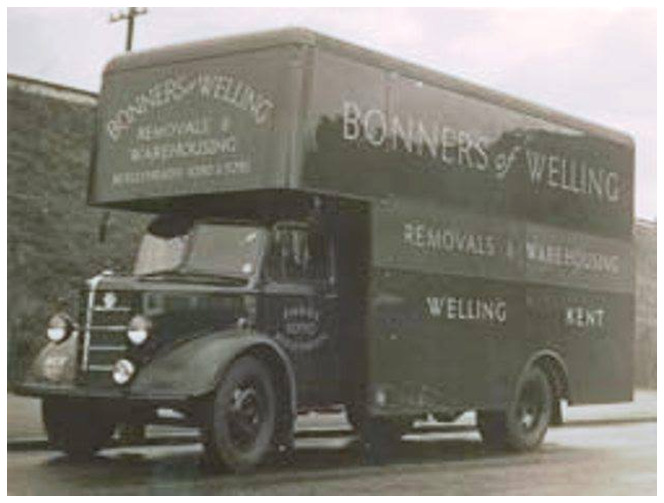
By 1939 and the national Register, we find that the Perrys had moved to the newly built Glenmore Road, Welling, on an estate built by Alabasters, the builders, in 1938. Harry was working as a ‘maintenance fitter/heavy worker’ and our Tom as a lorry driver – we know that he was employed by Bonners, a local removals company.
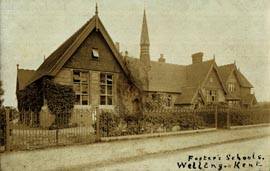
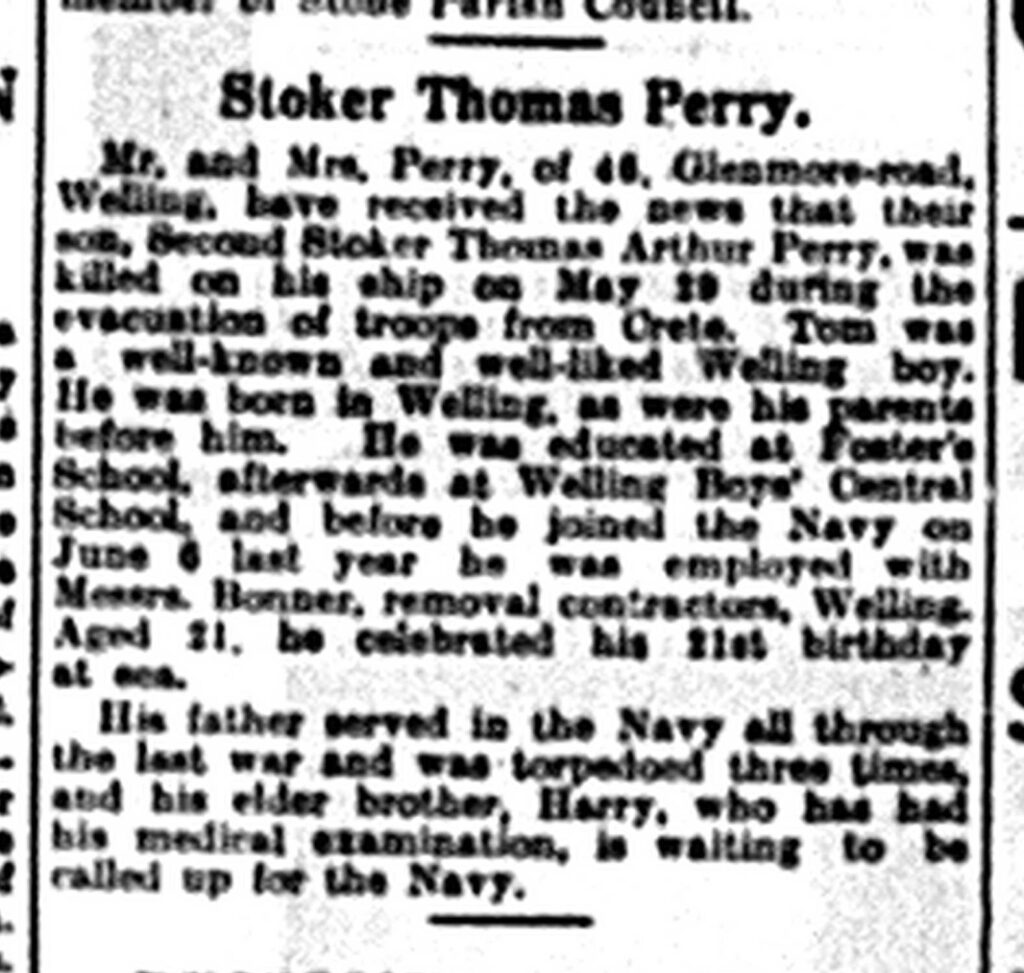
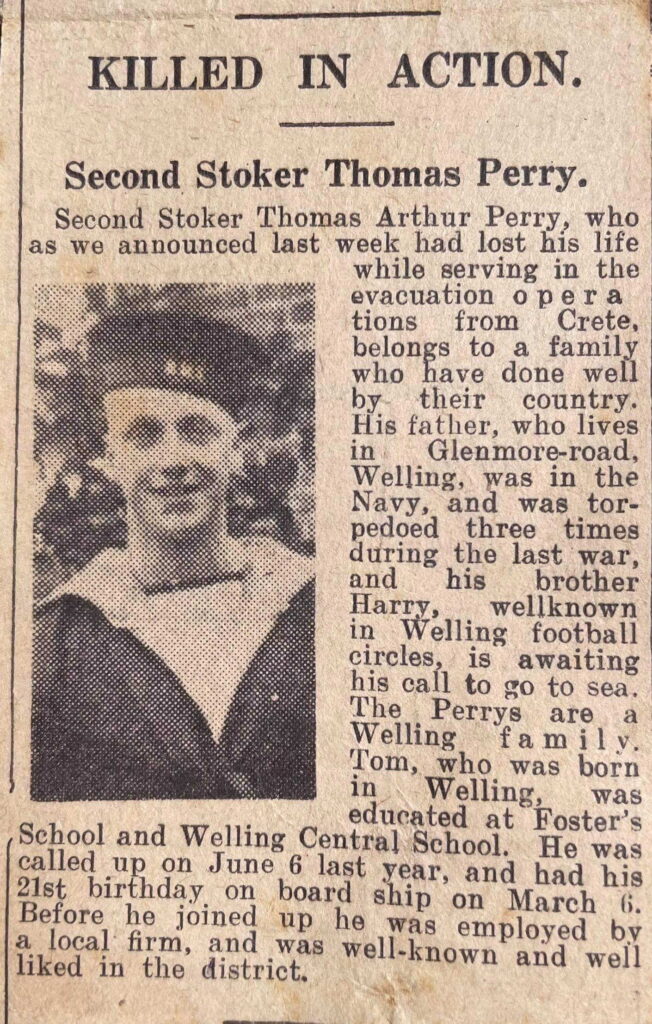
From various newspaper cuttings we know that Tom was educated at Foster’s School, then the Welling Central Boys School. “a darts player of some repute”, he was a “well-known and well liked Welling boy”…He had joined the navy in June 1940, and celebrated his 21st birthday at sea on active service.
His ship was HMS Dido
“HMS Dido’s keel was laid down on 26 October 1937 by Cammell Laird Shipyard of Birkenhead. She was launched on 18 July 1939 and commissioned on 30 September 1940 at Birkenhead. Following her commissioning, Dido was sent to Scapa Flow for working up in September 1940. Part of this included high-speed sweeps off Fair Isle and Greenland. Immediately after this, Dido’s first mission, in November 1940, was to escort the aircraft carrier Furious to West Africa, ferrying aircraft.
Dido then spent four months on convoy duty in the Atlantic before running supplies to Malta where she joined the Eastern Mediterranean Fleet in April 1941. In May of that year Dido was sent to Crete and assisted in the evacuation of the British forces. As part of a convoy from Souda Bay to Egypt on 14 May, she carried bullion from Greece worth $7,000,000. On 29 May 1941 Dido was badly damaged by bombs whilst taking troops from Crete to Alexandria.”
This evacuation of allied troops from Crete was a significant event of the war…the Germans had launched a huge airborne invasion of the island, and over 4000 British and Commonwealth servicemen were forced onto a fleet of navy vessels – many were sunk by enemy bombers – records suggest that on HMS Imperial “a group of Australian soldiers, semi-insensible from drink, had to be left below deck and went down with the ship”…
Tom’s ship, HMS Dido, taking part in this evacuation process, was also hit by a bomb from a Ju 87 “which exploded on dido’s B turret at 8.15 am…a great sphere of black smoke burst out ahead of her bridge. One of the guns curled up into the air and dropped smoking into the sea…the blast wrecked the marines’ mess deck and rescue was hampered by fire. It was impossible to reach the dead and wounded until damage control parties had brought the fires under control...”
All twelve of the gun crew were killed, along with a further 15 sailors (including our Tom, we assume) and 19 soldiers below decks.
When HMS Dido finally escaped the bombers, she had saved around a thousand troops, who were eventually safely disembarked at Alexandria. HMS Dido and the Royal Navy had kept its promise “not to let the Army down”…
One Royal Navy veteran survivor later wrote “I did a lot of things…I was in the D-Day invasion and landed on D-Day but Crete was the worst of all…”
(For more on HMS Dido see https://www.world-war.co.uk/dido_record.php)
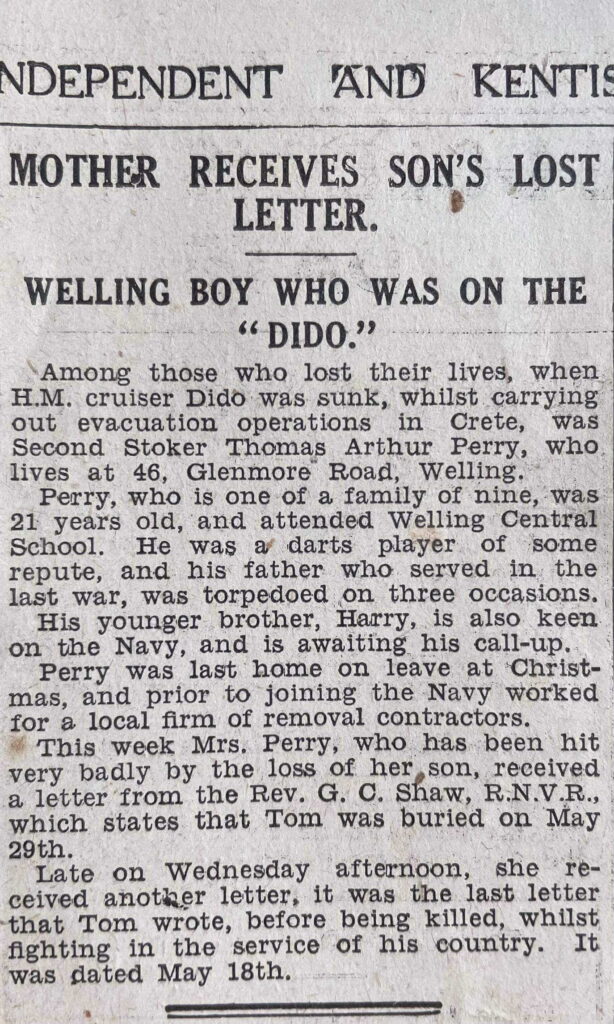
Another newspaper cutting tells us that Tom’s mother was ‘hit very badly by the loss of her son’…It also says, intriguingly, that he was buried on May 29th, although we can find no record of this…His name is, however, recorded on the Chatham naval memorial.
Chatham Naval Memorial
“After the First World War, an appropriate way had to be found of commemorating those members of the Royal Navy who had no known grave, the majority of deaths having occurred at sea where no permanent memorial could be provided.
An Admiralty committee recommended that the three manning ports in Great Britain – Chatham, Plymouth and Portsmouth – should each have an identical memorial of unmistakable naval form, an obelisk, which would serve as a leading mark for shipping. The memorials were designed by Sir Robert Lorimer, who had already carried out a considerable amount of work for the Commission, with sculpture by Henry Poole. The Chatham Naval Memorial was unveiled by the Prince of Wales (the future King Edward VIII) on 26 April 1924.
After the Second World War it was decided that the naval memorials should be extended to provide space for commemorating the naval dead without graves of that war, but since the three sites were dissimilar, a different architectural treatment was required for each. The architect for the Second World War extension at Chatham was Sir Edward Maufe (who also designed the Air Forces memorial at Runnymede, and was a one-time resident of Bexleyheath’s Red House) and the additional sculpture was by Charles Wheeler and William McMillan. The Extension was unveiled by the Duke of Edinburgh on 15 October 1952.
Chatham Naval Memorial commemorates 8,517 sailors of the First World War and 10,098 of the Second World War”
…………………………………………………….
Our images include pictures of Tom’s school and parents, his road – Glenmore Road – his removal company truck, and some newspaper cuttings.
…………………………………………………….
If anyone is able to add any extra information, provide more family details, or suggest any corrections, please let us know – also, if anyone has any more photos of this individual listed on our memorials, please get in touch. Thank you.



Commemorated
- St. Michael’s East Wickham Church Memorial Tablet
- Chatham Naval Memorial
This story has been researched by volunteers. We have taken every effort to ensure its accuracy. If you are related to Thomas Arthur Perry, or if you have any further information, please do get in touch.