


Died: HMS Cornwall was sunk by Japanese Aichi D3A dive bombers took off from three Japanese carriers, south-west of Ceylon
Address / Local links: 69 Swanley Road, Welling
Family / Relatives: Son of Oliver James and Elizabeth Dorothy Read, of Welling
Other Information: Son of a Storeman
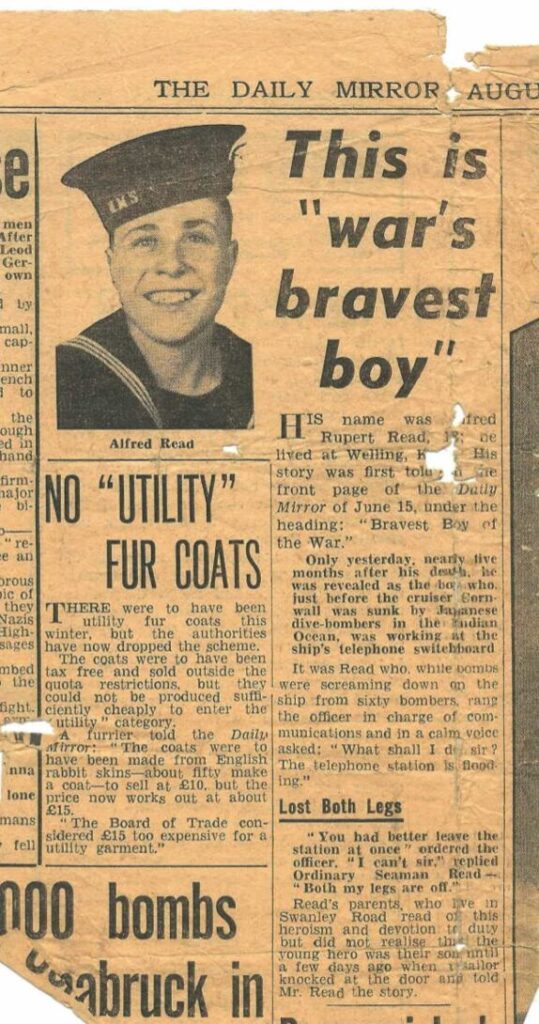
“This is war’s bravest boy” ran the headline in the Daily Mirror in the summer of 1942; it would have been a headline read with anguish by the boy’s father at home in Welling, himself an ex-Royal Navy Petty Officer…As the article explained, young Alfred Read’s officer had said to him after Japanese bombers had attacked his ship and flooded the telephone station “You had better leave the station at once”…” I can’t sir” replied our young hero, “both my legs are off”.
It was a tragic end for this handsome young sailor, who must have already endured great hardship during his short life. Alfred’s mother died when he was just five years old, leaving him and two brothers in the care of his father, Oliver, a sailor – presumably often away at sea.
We know little of Alfred’s early life. He was born on 28th February 1924 at Devonport, the Plymouth naval base. His mother, Clara Stapleton, was a local girl who had married Oliver James Read in Devenport in June 1921. She died 8 years later, aged just 33.
We don’t yet know anything of young Alfred’s childhood or upbringing, but we do know a bit more about his father, Oliver. A south Londoner, he went to Hitherfield Road School in Streatham, before joining the navy. A 1933 document records him as returning home to England from Japan on the liner Rawalpindi- to be received at the Royal Naval Hospital in Plymouth.
A 1935 document shows Petty Officer Oliver J Read as a holder of the King George V Silver Jubilee Medal (1935). A busy year, evidently, for he also married (in Deptford) Dorothy Elizabeth Sanders…a few months later, they had a son.
By 1939, we can trace the Read family to 69 Swanley Road in Welling, where Oliver is recorded as being a storekeeper at Woolwich Arsenal. It was here, according to the report in the Daily Mirror, that they would have heard of Alfred’s death, and later, when “a sailor knocked at their door and told Mr. Read the story”…
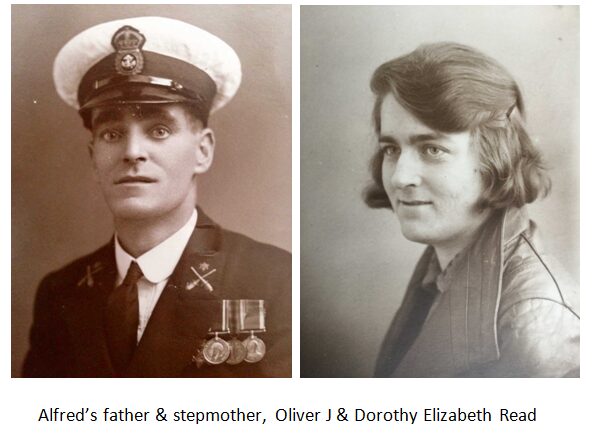
The Reads continued to live in the same house in Swanley Road until the early 1960s. Oliver died in 1965, Dorothy (Alfred’s stepmother) in 1987 – we have pictures of them both.
We wonder if they would ever have travelled to Chatham, to see Alfred’s name on the naval memorial there?…
Chatham Naval Memorial
“After the First World War, an appropriate way had to be found of commemorating those members of the Royal Navy who had no known grave, the majority of deaths having occurred at sea where no permanent memorial could be provided.
An Admiralty committee recommended that the three manning ports in Great Britain – Chatham, Plymouth and Portsmouth – should each have an identical memorial of unmistakable naval form, an obelisk, which would serve as a leading mark for shipping. The memorials were designed by Sir Robert Lorimer, who had already carried out a considerable amount of work for the Commission, with sculpture by Henry Poole. The Chatham Naval Memorial was unveiled by the Prince of Wales (the future King Edward VIII) on 26 April 1924.
After the Second World War it was decided that the naval memorials should be extended to provide space for commemorating the naval dead without graves of that war, but since the three sites were dissimilar, a different architectural treatment was required for each. The architect for the Second World War extension at Chatham was Sir Edward Maufe (who also designed the Air Forces memorial at Runnymede, and was a one-time resident of Bexleyheath’s Red House) and the additional sculpture was by Charles Wheeler and William McMillan. The Extension was unveiled by the Duke of Edinburgh on 15 October 1952.
Chatham Naval Memorial commemorates 8,517 sailors of the First World War and 10,098 of the Second World War”
Here is the story of his ship, and its final days…
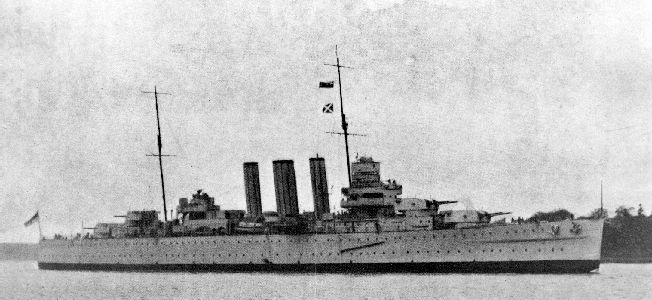
HMS Cornwall
“HMS Cornwall, pennant number 56, was a County-class heavy cruiser of the Kent sub-class built for the Royal Navy in the mid-1920s. The ship spent most of her pre-World War II career assigned to the China Station. Shortly after the war began in August 1939, she was assigned to search for German commerce raiders in the Indian Ocean. Cornwall was transferred to the South Atlantic in late 1939 where she escorted convoys before returning to the Indian Ocean in 1941. She then sank the German auxiliary cruiser Pinguin in May. After the start of the Pacific War in December 1941, she began escorting convoys until she was transferred to the Eastern Fleet in March 1942…
On 2 April, Cornwall and her half sister, Dorsetshire, were detached from the fleet, Dorsetshire to resume an interrupted refit and Cornwall to escort convoy SU-4 (composed of the U.S. Army transport USAT Willard A. Holbrook and Australian transport MV Duntroon) to Australia and the aircraft carrier Hermes to Trincomalee in Ceylon for repairs. On 4 April, the Japanese fleet was spotted and the two cruisers left harbour and, after a hurried refuelling at sea, set out for Addu Atoll shortly after midnight. The following day, the two cruisers were sighted by a spotter plane from the Japanese cruiser Tone about 200 miles (370 km) south-west of Ceylon…
The Royal Navy’s own ‘Pearl Harbour’
As part of the engagement known as the Easter Sunday Raid, a wave of Aichi D3A dive bombers took off from three Japanese carriers to attack Cornwall and Dorsetshire, 320 kilometres (170 nmi; 200 mi) south-west of Ceylon, and sank the two ships. British losses were 424 men killed; 1,122 survivors spent thirty hours in the water before being rescued by the light cruiser Enterprise and two destroyers”.
Sub-Lieutenant R. Ellis Brown was one survivor – he subsequently wrote – “Almost immediately afterwards there was a terrific explosion and the ship lifted out of the water and listed to port, “ he said. “This was followed almost immediately by another hit. The lights went out and I continued on to the sick bay. I went forward from there to contact the control officer and shortly after I left, a bomb dropped on the sick bay, killing most of the men there. I could not get through on account of the flames, so went to the aft deck. Here we managed to get a whaler and also five or six floats. We got the men off and I looked up and saw a dive-bomber coming down at me. I saw the bomb released at about 700 feet and it appeared to be coming straight at me. Although I knew that if a bomb appeared to be coming straight at you it would actually fall far beyond. I must say I did not like it one bit. The men jumped into the water and finally the two other officers and myself left on this deck followed them.”
“We really were sitting ducks” wrote another survivor – you can read his full and harrowing story here: https://www.world-war.co.uk/cornwall_loss.php
We know now that Alfred Read was among those lost at sea that day – he was just 18 years old.
…………………………………………………….
Pictured are the article from the Daily Mirror, Alfred’s father and stepmother, and images of HMS Cornwall.
…………………………………………………………………….
If anyone is able to add any extra information, provide more family details, or suggest any corrections, please let us know – also, if anyone has any more photos of this individual listed on our memorials, please get in touch. Thank you


Commemorated
- St. Michael’s East Wickham Church Memorial Tablet
- Welling War Memorial
- Chatham Naval Memorial
This story has been researched by volunteers. We have taken every effort to ensure its accuracy. If you are related to Alfred Rupert Read, or if you have any further information, please do get in touch.