


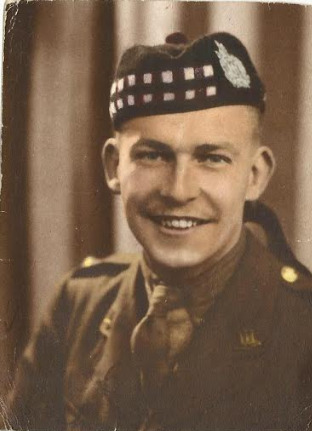
Died: Shot while trying to escape from POW camp
Address / Local links: 3 Cambridge Avenue, Welling
Family / Relatives: Son of James Mitchell and Isabella Short of Westwood Lane. Husband of Stella Violet Short of Welling
Local Papers / Websites: BHO 14th January 1944. http://gallery.commandoveterans.org/cdoGallery/v/units/5/Short/JC+Short+and+wife_copy.PNG.html
Other Information: Attended Welling Boys’ Central School and Dartford GS – OTC. Army Reservist. Policeman in Esher
Campo PG 78/1 Prisoner of War Camp
Jack Cameron Short’s adventurous but brief life was cut tragically short at the Italian Campo PG 78/1 Prisoner of War Camp
“A Second World War prisoner of war camp in central Italy. It opened about March 1943 and was under the administration of Campo PG 78 at Sulmono. It was situated about 2,000 feet up in the hills to the north east of Sulmono, and was used as a work camp for POWs”
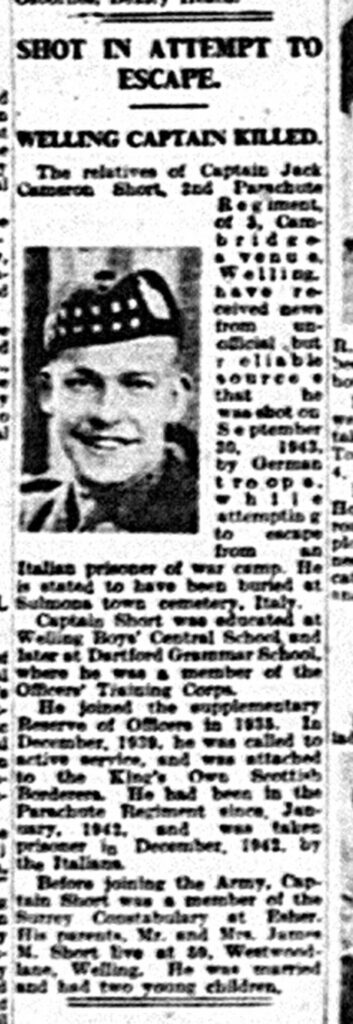
Documents tell us that he was “on 30 September 1943 shot and killed attempting to escape”…
Other military documents tell us of Jack’s earlier military career and promotions, starting soon after the outbreak of war;
15 December 1939 (Lieutenant) King’s Own Scottish Borderers.
1941 (Lieutenant) attached No.5 Commando.
1 August 1942 (Lieutenant) posted to the Parachute Regiment.
1 December 1942 (Captain) reported missing in North Africa whilst serving in 2nd Bn., The Parachute Regiment, A.A.C.. This was 2 days after his unit parachuted into Depienne for an operation at Oudna, nine miles from Tunis. Later found to have been taken prisoner of war. Imprisoned at Camp (PG) 21 at Chieti, Italy, and later Camp (PG) 78 at Sulmona, Italy.
30 September 1943 shot and killed attempting to escape.
Jack Cameron Short
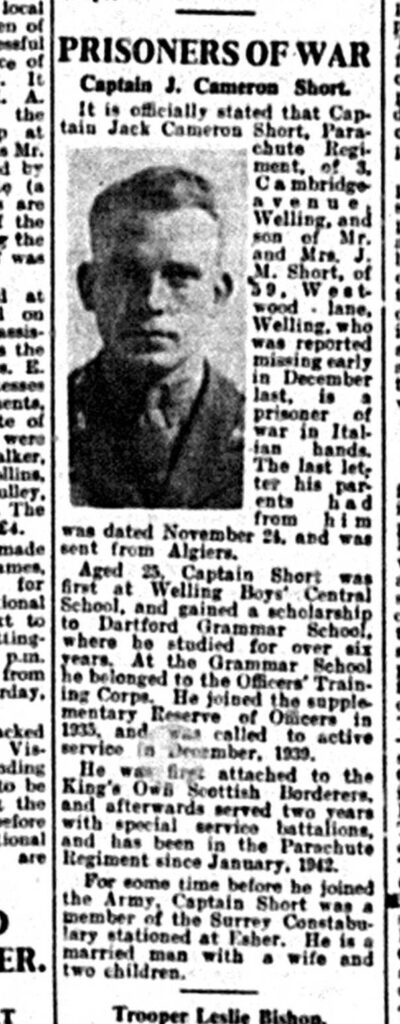
As the newspaper cuttings tell us, evidently Jack had led an adventurous life, with early connections to the army, and later the police.
Educated at Welling Boys’ Central School and later on a scholarship at Dartford Grammar School where he joined the thriving Officer Training Corps (OTC), he then became a police constable stationed at Esher in surrey.
Jack had also joined the Supplementary Reserve of Officers in the mid 1930s, and must have been aware that war was looming once again on the Continent…after three months of war, Jack was called to active service in December 1939 as a young Lieutenant. Three years later, in December 1942, he was captured in North Africa, and subsequently taken to Italy as a POW. He was never to return home.
Jack Cameron Short was born on 8th October 1917 in Bexleyheath and baptised three days later at Christ Church, Bexleyheath. The baptism register gives the family address as 6 Granville Road Welling, and his father’s trade as ‘engineer’.
Jack’s parents – James Mitchell Short (1882-1968) & Isabella (nee Cameron 1884-1965) had married in August 1908 in Northumberland – they were both from the north-east, James from Alnwick, Isabella from Lemington On Tyne. (James’ father had been a police sergeant, so clearly the family had long standing links with the law).
By the time of the Great War, James’ engineering trade had brought him down south, and the family were living in Welling. The had 4 children in total – Charlotte, Dorothy Ann, James (“Jimmy”) Mitchell, and Jack – the youngest.
By the late 1930s the family had moved to 36 Marlborough Road. The 1939 Register list James as being an `engineer – shell product`, James jnr ‘machine hand – shell product’ and charlotte ‘incapacitated’. Jack himself was listed as a former police constable.
Stella V Short
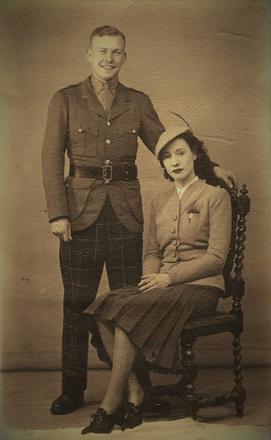
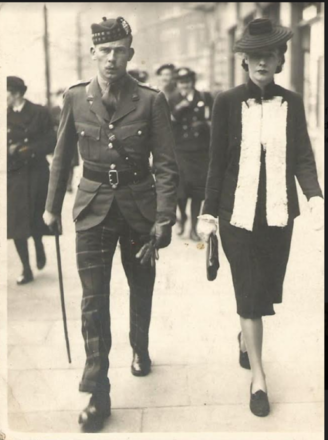
Jack married the following year, on St. George’s Day 23rd April 1940 at St. John’s Welling. His wife was a Welling girl, Stella Violet Hawkins of 3 Cambridge Avenue. The daughter of a Thames Lighterman, Stella’s profession was listed as ‘Dress Designer’. (Photographs of her always show a stylish lady). They had two children, who would grow up without knowing their father.
Stella, apparently, went on to have a long and eventful life. In February 1945 she married, again at St. John’s Welling, William Foster, a Texan; they moved to Texas, along with Stella’s mother and children. The marriage, however, did not last, and they divorced in February 1948 – archive documents list them as travelling back to England on the Queen Mary before settling back home at Cambridge Avenue. Here she reverted to the name ‘Stella V Short’.
In 1965 she married Janusz Sygmunt Krause, a Naturalised Polish citizen (aka John David Selwyn-Cross) – they subsequently moved to South Africa, where Stella died in 2006 aged 89.
The Moro River Canadian War Cemetery
This was, obviously, a long way in time and place from her first husband’s burial place in Italy. After being shot while attempting an escape, Jack’s body was laid to rest at The Moro River Canadian War Cemetery, high on a hill in central Italy near the Adriatic coast… In January 1944 the Canadian Corps, who had been heavily involved in the fighting here, selected this site, intending that it would contain the graves of those who died during the Ortona battle and in the fighting in the weeks before and after it. Today, there are 1,615 graves in the cemetery, of which over 50 are unidentified and 1, 375 are Canadian.
The Commonwealth War Graves Commission give more details about the cemetery; The Moro River Canadian War Cemetery
On 3 September 1943 the Allies invaded the Italian mainland, the invasion coinciding with an armistice made with the Italians who then re-entered the war on the Allied side. Allied objectives were to draw German troops from the Russian front and more particularly from France, where an offensive was planned for the following year. Progress through southern Italy was rapid despite stiff resistance, but by the end of October, the Allies were facing the German winter defensive position known as the Gustav Line, which stretched from the river Garigliano in the west to the Sangro in the east. The Allied force that had fought its way up the Adriatic took the Sangro river positions by 30 November. The 1st Canadian Division went on to cross the Moro river on 6 December against stiff opposition, and to take Ortona on the 28th, after a week of bitter street fighting. The 2nd New Zealand division made some advances further inland but thereafter, there was virtually no movement east of the Appennines until after the fall of Rome. The site of the cemetery was chosen by the Canadian Corps in January 1944. It contains the graves of those who died during that fighting at Moro river and Ortona, and during the weeks that preceded and followed it. In December 1943 alone, the 1st Canadian Division suffered over 500 fatal battle casualties. Burials other than those of members of the Canadian forces are almost all in plots 12, 13 and 16. Moro River Canadian War Cemetery contains 1,615 Commonwealth burials of the Second World War.
HE DIED AS HE LIVED GLORIOUSLY AND BRAVE is the inscription on Jack’s headstone.
Nearer home, you can still see Jack’s name on the Welling War Memorial, in the grounds of St. John’s church – the very place where they married in 1940.
……………………………….
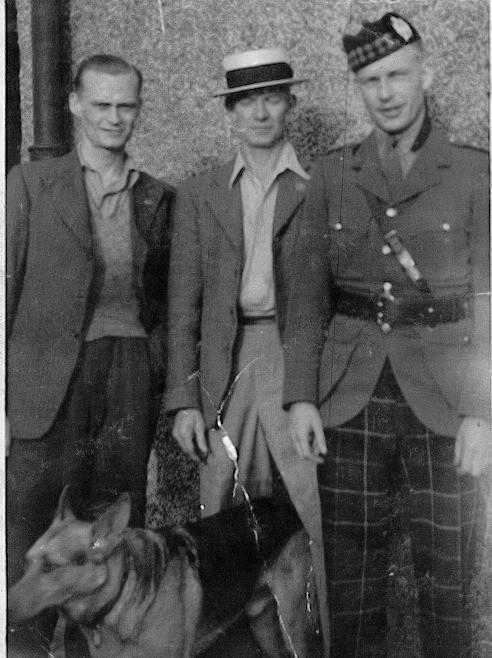
Pictured, along with the two press articles, are his family (wife, father & brother), the POW camp in 1942, his burial place and headstone, and St. John’s Church in Welling – where he married and where the town’s war memorial now stands.
…………………………………………….
If anyone is able to add any extra information, provide more family details, or suggest any corrections, please let us know – also, if anyone has any more photos of this individual listed on our memorials, please get in touch. Thank you.


Commemorated
- Welling War Memorial
- Moro River Canadian War Cemetery, Italy
This story has been researched by volunteers. We have taken every effort to ensure its accuracy. If you are related to Jack Cameron Short, or if you have any further information, please do get in touch.