


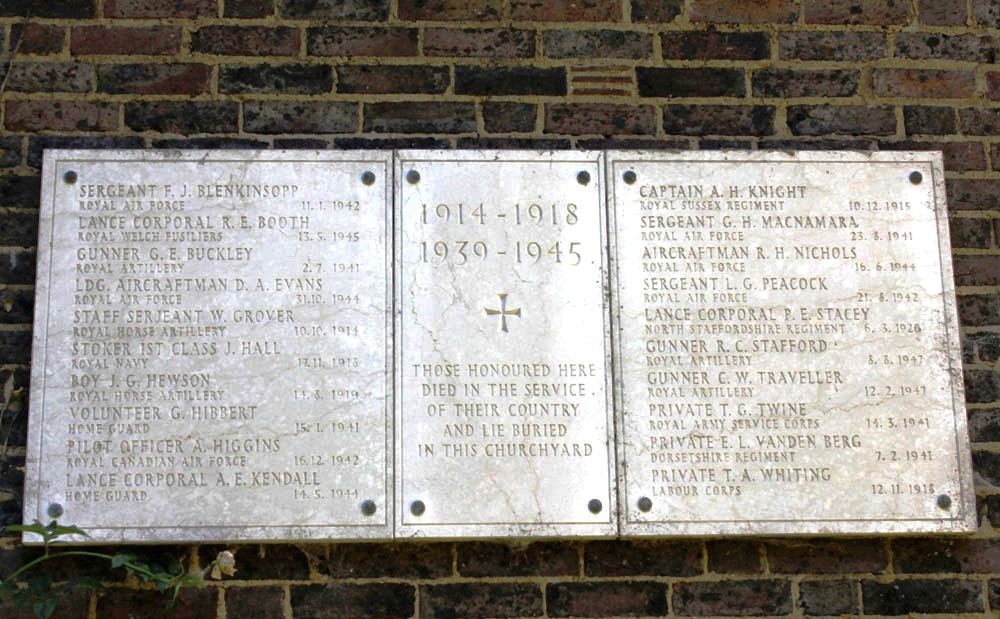
Percy Ernest Stacey was born on about the 14th June 1892 in West Silvertown, Essex and was the son of James Stacey, a brewer’s drayman born in Newborough, Northamptonshire and Rose Ellen Stacey, originally from Bourne, Lincolnshire. Percy had one sister, Rose Olive who was 8 years younger. Before moving to Welling, the family had lived in at 9 Regent Road, Spalding, with Percy working for Johnson Brothers of Spalding as an ironmonger’s porter and fitter’s labourer before enlisting in his County Regiment.
Percy volunteered to join the 1st Battalion of the Lincolnshire Regiment at the outbreak of war on the 1st September 1914 at Spalding but had to wait until the 4th December that year to be enlisted. He was 22 years old, 5′ 9″ and weighed 9 stone. The battalion that he was to join had landed at Le Havre 14th August 1914.
For most of his service Percy was with the 1st Battalion Lincolnshire Regiment (Service No. 10849) part of the 9th Brigade, 3rd Division but from 14th November 1915, the battalion transferred to the 62nd Brigade, 21st Division. From the 4th March 1918 Percy was posted to the 8th Battalion North Staffordshire Regiment (Service No. 235309), part of 56th Brigade, 19th (Western) Division.
Percy started his active service on the Western Front on 15th July 1915 as a Rifle Bomber. On 11th August 1916 Percy was taken out of the line to hospital with wounds and severe shell shock whilst in action on the Somme. He returned to active service and was badly wounded by machine gun fire to his jaw on 26th September 1917, losing 6 teeth, whilst his battalion were at this time engaged in the Battle of the Menin Road, during the 3rd Battle of Ypres. Following these wounds he was not returned to service until the 25th January 1918 when he was transferred to the 3rd Battalion of the Lincolnshire Regiment for policing service in Cork to counter the Irish rebellion.
He again returned to active service on 8th March 1918 this time with the 8th North Staffs and was again wounded on 5th November 1918 (6 days before war ended!) when he received a bullet wound to the area of the abdomen, pelvis and liver, whilst in action in the Valciennes area of Northern France during the 2nd Battle of the Sambre. He was transferred back to England on 3rd December 1918, and his rank reverted back to a private.
By December 1918 complications had set in and Percy was suffering from pulmonary tuberculosis to the left lung. Doctors described his condition as poor, and he was also suffering from slight eczema and an enlarged thyroid gland. His army medical record also states that this had been caused by ‘exposure and his active service conditions’. In early February 1919 he completed a medical form and described his own condition as “Bullet wound through jaw 26.9.17. Wounds now healed but 6 teeth missing. Can only eat on one side of the mouth. Machine gun bullet wound about Dec 1918. Caused through exposure and active service conditions. Now very weak and shaky and in bed. Require sanatorium treatment.”
On 13th February 1919, after attending an Army Medical Board and after a period in Military Hospital , Percy was formally discharged from further army service. The Army release forms stated that Percy had a year to live. A pension was awarded to him of 27/6d per week.
Lance Corporal Percy Stacey died 13 months later on 6th March 1920 aged 27, back with his family, who were now living at 70 Bruce Road, Welling, Kent. Percy was buried at St. Michael’s Church, East Wickham, Kent on the 13th March 1920 with the following rather apt epitaph on his tombstone:
“Earth’s pains ended, Heaven’s riches gained”
Commemorated
- Commonwealth War Graves Commission Memorial
- East Wickham and Welling War Memorial
- East Wickham and Welling War Memorial Hall
Links
This story has been researched by volunteers. We have taken every effort to ensure its accuracy. If you are related to Percy Ernest Stacey, or if you have any further information, please do get in touch.