


Address / Local links: c/o Gibsons Farm, Wickham Street, Welling
Family / Relatives: Son of James and Jane Wellings of Welling. Jane, a widow resident in a caravan on Gibsons Farm (1939)
The surname ‘Wellings’ is an appropriate one for a local family with apparently deep but hidden roots in and around Welling and East Wickham…
James Wellings is a bit of a mystery as no records can be traced for him or his family prior to the 1939 census. On this census return it states that James was born on the 15th December 1915 and that he was working as a General Labourer. He is living with his mother Jane Wellings in a caravan on Gibsons Farm, Wickham Street.
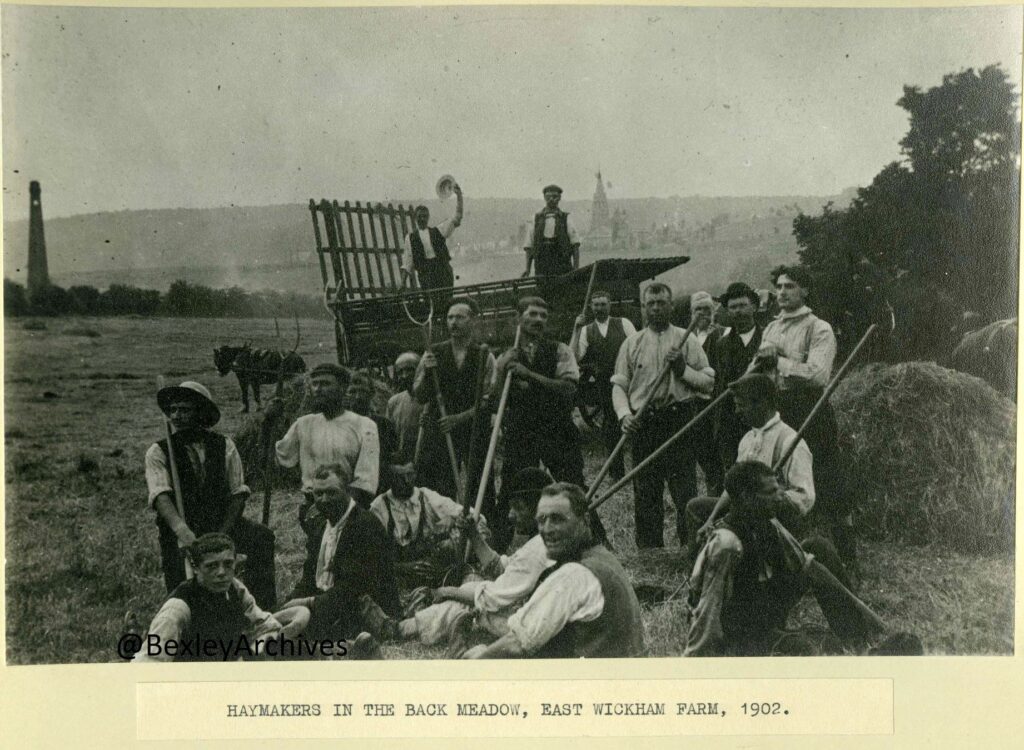
The Gibsons of East Wickham Farm
“The Gibsons developed East Wickham Farm – which probably dates back to medieval times – from the early1900s onwards and for many in the area it then became known as Gibson’s Farm.
Lewis Bruce Gibson – although he was often known as Bruce L. Gibson – was “a much respected figure in the community”. He was born c1866 in Eynsford Kent to William & Eliza Gibson. William Gibson is described in the 1881 census as master smith employing 12 men and in 1891 as a retired (at 64!) agricultural implement maker. In 1891 his son Bruce is working as a surveyor to the Darenth Valley Sewerage Co but by 1901 he is married to Rosetta or Rose Elizabeth who was from Crockenhill and has become a farmer at East Wickham. There were two children Ewart Bruce and Marjorie.
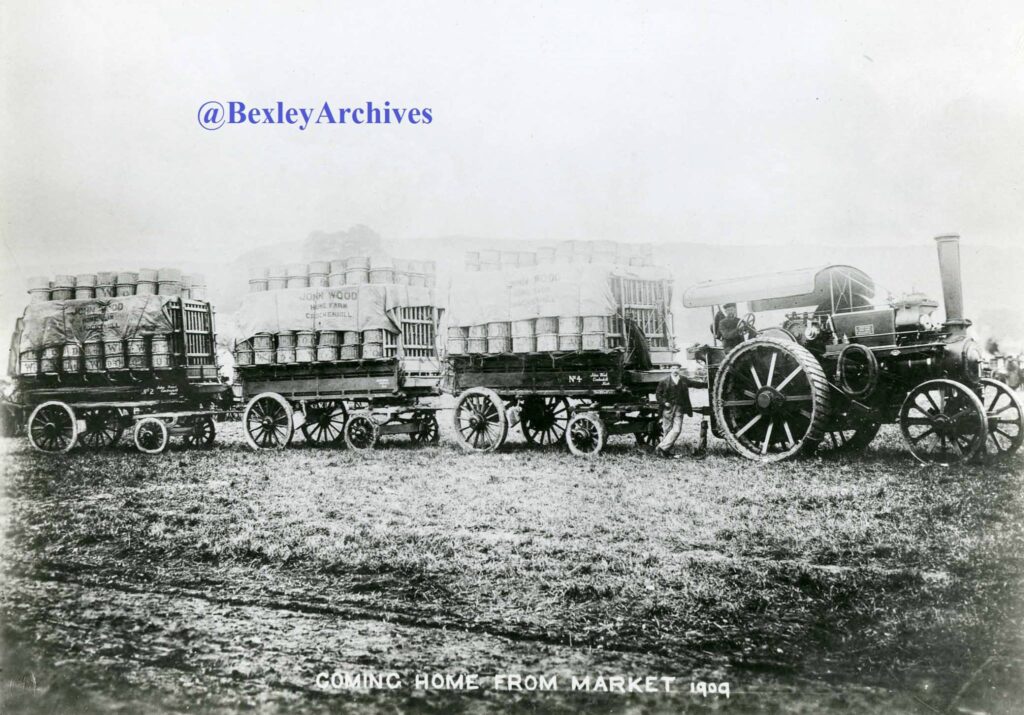
Gibson’s Farm did well and the family grew wealthy supplying London markets with fresh produce, sent up to town by train – their lands stretched as far as Brampton Road in Bexleyheath. Much of this land was later sold off for housing, but part of it remains as East Wickham Open Space. Bruce Gibson was a member Bexley Urban District Council and the Dartford Board of Guardians. When he died in February 1939 he left over £80,000 – the equivalent today would be over £5,000,000. Mrs Gibson died in her 92nd year in January 1953 at the Farm”.
Jane Wellings is recorded as being a widow and was born on the 11th May 1873. However there seems to have been some kind of name change as the name Wellings has been crossed out and the name Pearce written above with the date of 19th June 1946. Upon investigating, an entry in the death register for this year shows that a Jane Pearce died on this date in Dartford. So did Jane re-marry (no record has been found to substantiate this), or did she reverted back to using her maiden name when widowed. Regrettably no records have been traced to confirm her date of birth or marriage.
Unfortunately it is the same situation with regards to his father James, no records have been traced for him. All we know is that he must have died prior to 1939.
As the 1939 census tells us that James and his mother were living in a caravan it is possible that they were Travellers and therefore living such a transient life they did not legally register their life’s events or if they did, it could have been anywhere in the country making it very hard and/or impossible to trace them.
According to the army records that have been found they state that James was 29 years old when he died, that he was born in East London and his parents were James and Jane Wellings. He died of his wounds in Athens on the 10th December 1944. It is not known when he joined the Army but his service number indicates that it could have been during the early part of the War. The prefix letter of T denotes that he was in Transport. According to information found he could well have seen action in Europe, North Africa, Italy and finally Greece. How James was fatally injured is not known but it is possible that it was at the hands of a Greek guerrilla force and not the Germans. In December 1944 the 331 Company of the RASC was part of the British Liberation Force that found themselves involuntarily and unhappily involved in the violence and hatred of the Greek Civil War which followed the withdrawal of the German occupying forces from the country.
In October 1944 the 331 Company of the RASC arrived in Greece as part of the British Liberation Force where they settled into the barracks at Athens. The Liberation Force believed their mission would be limited to supporting the legal Greek Government in setting up its administration and to help with the relief work. At the beginning of December a mere six weeks after the return of a ‘liberation’ government in Greece, fighting broke out and they found themselves the targets of the communist controlled forces EAM/ELAS which endeavoured to take over the country by force. The fighting was mostly limited to Attica (Athens) and part of Piraeus. The small British Garrison in Athens had a difficult time being cut off and surrounded in a tight perimeter in the centre of the city, besieged by superior and well-armed rebel forces. It took five weeks of brutal and bitter street fighting against an elusive opponent. It was not until the arrival of a considerable reinforcement from overseas that the British were able to break the siege and drive the insurgents out of the city. A final truce came into effect in January 1945.
James was buried in the Phaleron War Cemetery, Athens (19.B.20). the inscription reads;
AMIDST THE SHOT AND SHELL
FOR HIS COUNTRY’S SAKE
HE GAVE HIS LIFE
AND STOOD HIS TRIAL WELL
Phaleron War Cemetery lies a few kilometres to the south-east of Athens.
The site of what is now the Phaleron War Cemetery was chosen originally by the 4th Division as a burial ground for Commonwealth casualties of the Greek Civil War (December 1944-February 1945). Subsequently, the military authorities, in conjunction with the Greek Government and the Army Graves Service, decided that it would be the most suitable site for a Second World War cemetery for the whole mainland of Greece. The 23rd and 24th Graves Registration Units and the 21st and 22nd Australian War Graves Units worked together to bring in graves of the 1941 campaign from the battlefields, temporary military cemeteries and from various civil cemeteries.
There are now 2,029 Commonwealth servicemen of the Second World War buried or commemorated in this cemetery. 596 of the burials are unidentified. Special memorials commemorate casualties known to have been interred in certain groups of graves in the cemetery, but whose individual graves cannot be precisely located within these groups. Other special memorials commemorate casualties re-buried in the cemetery from original graves which, owing to the destruction of local records, could not be identified.
Also within the cemetery are: The PHALERON CREMATION MEMORIAL, commemorating 74 men of the army of undivided India who died during the campaigns in Greece and Crete during the Second World War and who were accorded the last rite required by their religion – committal to fire.
The ATHENS MEMORIAL, commemorating nearly 3,000 members of the land forces of the Commonwealth who lost their lives during the campaigns in Greece and Crete in 1941 and 1944-1945, in the Dodecanese Islands in 1943-1945 and in Yugoslavia in 1943-1945, and who have no known grave.
In the north-east corner of the cemetery, a plot contains the graves of servicemen and civilians who after serving in the Crimean War, died in Greece, and were buried in the Anglo-French Crimean Cemetery, New Phaleron. The graves were moved in 1966 when that cemetery could no longer be maintained.
The CEMETERY and the ATHENS MEMORIAL were designed by Louis de Soissons.
When Probate was administered in May 1945 it stated that the sum of £107.7s 4d was left to Jane Wellings, widow.
He is not only remembered on the Memorial Tablet in St Michael’s Church, East Wickham but also by the Commonwealth War Graves Commission.
……………………………………………………………….
If anyone is able to add any extra information, provide more family details, or suggest any corrections, please let us know – also, if anyone has any more photos of this individual listed on our memorials, please get in touch. Thank you.
Pictured are some Bexley Archives images of East Wickham Farm, as the Wellings may have known it, and the Phaleron War Cemetery, Athens., and James’ military casualty record.



Commemorated
- St. Michael’s East Wickham Church Memorial Tablet
- Phaleron War Cemetery, Greece
This story has been researched by volunteers. We have taken every effort to ensure its accuracy. If you are related to James Wellings, or if you have any further information, please do get in touch.