


Died: Vickers Wellington III, lost over Germany
Address / Local links: Bellegrove Road, WellingFamily / Relatives:
Family / Relatives: Son of William and Hilda Wilding, of Bellegrove Road Welling. Husband of Pamela Wilding
Other Information: A Cinema Ledger Clerk in 1939
It’s a far cry from being a cinema ledger clerk in 1939 to an RAF Sergeant radio operator/air gunner a year or so later, but that was the role of our Norman Wilding.
WIRELESS OPERATOR/AIR GUNNER – the role, according to the Imperial War Museum’s experts…
The wireless operator transmitted all messages to and from the aircraft to their base. He had fewer duties than the other crew members as operations were generally conducted in wireless silence. However, he also served as the reserve gunner and addressed any minor emergencies in any part of the aircraft. If the aircraft got into difficulties he had to send out positional signals. If the aircraft had to ditch into the sea, he had to remain at his post to send out a distress signal to improve the crew’s chance of being located and rescued.
The Wilding family
Norman was born on 31st January 1916 – his Parents address was given as 21 Whitworth Road Plumstead although he was actually baptised at St. Leonards Sussex in June 1916…Norman’s father’s trade was given as ‘musician’ so perhaps he was touring or on war service? He came from Hastings, so perhaps he was visiting his family?
We know that Norman’s father – William Seymour Wilding (1889-1951) was a musician, a pianist according to some documents. He was also a Mason, a member of the Valentia Lodge.
In 1911 William Seymour Wilding married Hilda Harris (1890 – 1965), a Plumstead girl. They had two more sons before Norman was born in 1916.
In the late 1930s we find the Wilding family living in Welling at 112 Bellegrove Road – after the war they’d moved a few doors up to 347 Bellegrove Road.
Intriguingly, the 1939 Register finds the Wildings living just up the hill in Woolwich – 218 Herbert Road. William Seymour Wilding (a pianist), a son Robert (a clerk and p/t AFS Fireman), and our Norman – a 23 year old `Ledger Clerk (Cinema)’. Sadly, we don’t know which cinema he was working at, but it’s quite likely to have been one in Welling.
Also living there at Herbert Road was 22 year old shorthand typist Pamela V Haylor who must have caught Norman’s eye…a year later, in Blackpool, they married in September 1940. As we now know, it was to be a short lived marriage. (Pamela remarried in 1944, and went on to live until her 100th year).
Norman was soon in the RAF, serving with 57 Squadron.
57 Squadron
No.57 Squadron began the Second World War as a Blenheim squadron, and in September 1939 was one of the first RAF squadrons to move to France, where it operated as a strategic reconnaissance unit.
After the start of the German offensive in the west, on 10 May, the squadron began eight days of costly attacks on German columns, before a combination of heavy losses and the rapid German advance meant it had to be withdrawn to England. Reconnaissance missions continued throughout June, before in July the squadron was moved north to Scotland.
A few months of anti-shipping operations over the North Sea followed, before in November 1940 the squadron moved south to convert to the Vickers Wellington. On 13 January 1941 the squadron flew its first night bombing mission, the role it would continue to perform for the rest of the war. Lancasters arrived in September 1942, by which time the squadron was part of No.5 Group. The squadron operated the Lancaster as part of Bomber Command’s main force from then until the end of the war, taking part in the 25 April 1945 attack on Hitler’s mountain retreat at Berchtesgaden, and in the final Lancaster operations of the war, when four aircraft from the squadron dropped mines in Oslo Fjord.

The Kassel raid
In the late summer of 1942 the squadron was heavily involved in massive night bombing raids over Germany…At 21.05 on 27 Aug 1942 Norman and his crew from Feltwell Aerodrome in Norfolk took off in their Wellington bomber…
An official history records “Kassel Raid – 306 aircraft sustained 31 losses (10.1%). PFF f(Pathfinder Force) ound little cloud cover and were able to mark the target without difficulty. Widespread damage throughout the city, including damage to all three of the Henchel aircraft factory. At this extraordinary loss rate, an airman stood less than 0.5% chance of surviving his two tours.”
Norman’s plane, a Vickers Wellington III X3331 was one that was shot down;
“Pilot Officer D Gill, Sergeant J D Parkinson, Sergeant N S Wilding: killed; Sergeant J B F Mathews, Pilot Officer V G Saunders, Pilot Officer C A Punchard: prisoners of war; Wellington X3331, 57 Squadron, aircraft failed to return from an operational flight over Kassel, Germany, 28 August 1942”
Norman and his two colleagues were later buried in the Reichswald Forest War Cemetery.
Reichswald Forest War Cemetery, Germany
Reichswald Forest War Cemetery was created after the Second World War when burials were brought in from all over western Germany and is the largest Commonwealth cemetery in the country.
Some of those members of the land forces buried there died in the advance through Reichswald Forest in February 1945. Others died crossing the Rhine, among them members of the airborne forces whose bodies were brought from Hamminkeln, where landings were made by the 6th Airborne Division from bases in England.
Some of the airmen buried in the cemetery lost their lives in supporting the advance into Germany, but most died earlier in the war in the intensive air attacks over Germany. Their graves were brought in from cemeteries and isolated sites in the surrounding area.
There are now 7,594 Commonwealth servicemen of the Second World War buried or commemorated in the cemetery. 176 of the burials are unidentified. There are also 78 war graves of other nationalities, most of them Polish.
Special Memorials to 9 airmen are located at the East boundary wall, near Plot 10. Further Special Memorials to 7 airmen are located within Plot 31, near the Cross of Sacrifice.
The cemetery was designed by Philip Hepworth, one of the Principal Architects of the Imperial War Graves Commission (now the Commonwealth War Graves Commission).
The inscription on Norman’s headstone reads; TO WHAT GREATER HEIGHT CAN A MAN ASPIRE THAN TO DIE THAT WE MIGHT LIVE.
Today, you can still see Norman Wilding’s name on the Welling War Memorial.
……………………………………………………………………………………………………………
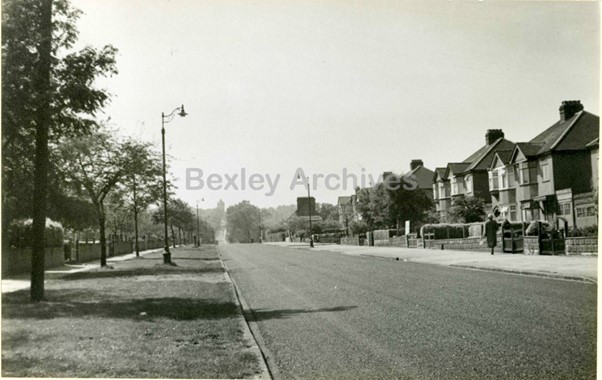
Pictured are Bellegrove Road, as Norman’s family would have known it in the postwar years, the Granada Cinema in Welling, an IWM image of some of the 57 Squadron at Feltwell, a Wellington bomber, and the Reichswald Forest War Cemetery.
…………………………………………………….
If anyone is able to add any extra information, provide more family details, or suggest any corrections, please let us know – also, if anyone has any more photos of this individual listed on our memorials, please get in touch. Thank you.


Commemorated
- Welling War Memorial
- Reichswald Forest War Cemetery, Germany
This story has been researched by volunteers. We have taken every effort to ensure its accuracy. If you are related to Norman Seymour Wilding, or if you have any further information, please do get in touch.