


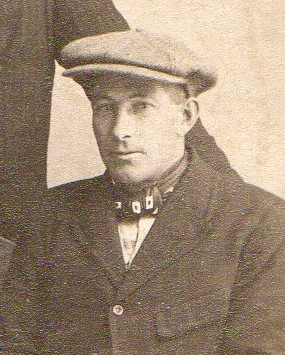
Walter Perfitt, known as Wally to his friends, was born on 19th January 1886 to parents James, an agricultural labourer, and Ellen. He was the eighth of nine children, though brothers William and Horace both died in 1895 aged 27 and 16 respectively, and James died in 1898, aged 22.
At the age of 5, on 1st September 1891, Walter started at Foster’s School where he attended until 1st May 1893, when he transferred to the Upper School. He was living with his family at Naggs Head Cottage in Welling at the time he started school.
By the time of the 1901 Census, the family were living at 7 Albert Place, Welling. Walter was 15 years old and an agricultural labourer. In 1905 his father, James, died.
At the time of the 1911 Census, Walter employed as a worker on S.E.C.(?) Railways and was living at 2 Penpool Lane, Welling, with Eliza Perfitt, and daughter Mary, who was a year old. Also in the household was a boarder, Mary Freeman, in employment as a domestic servant. Walter and Eliza stated that they had been married by then for 2 years but in fact their marriage certificate was dated 22nd July 1915 when they were both living at 88 Reidhaven Road Plumstead. They married at the Register Office, Woolwich, and bachelor Walter is recorded as being a ‘Private, 1st Buffs’, whilst Eliza, a spinster (Nee Vine) is a ‘field hand’.
At one point, Walter was a top, bare-knuckle street fighter. He fought another contender for the “title” of top fighter at Welling Corner, where the Russian cannon is now situated. The fight lasted three-quarters of an hour with neither man able to defeat the other, so they shook hands and went to the pub!
Walter enlisted with the 1st Battalion, East Kent (Buffs), which was a regular army battalion already in existence before the war started. At the outbreak of war, it was stationed at Fermoy, in Ireland with 16th Brigade, 6th Division, moving to Cambridge on 19th August 1914 where it was billeted in the university grounds. On 10th September 1914 the battalion landed at St Nazare, France and rushed to help the British Expeditionary Force, which was, at the time, retreating from fierce fighting in Mons, Belgium. Many of the soldiers were veterans of the Boer War, and once in France, they fought fiercely continuing to do so until the end of the war, when they were in Bohain, France.
The batallion was later moved to Germany (the only Buffs battalion to enter Germany) and returned home to Canterbury in 1919. Altogether around 1200 men were killed throughout the war. Walter was killed in action on 14th May 1916. His death was reported in the local Observer on 30th June 1916:
Particularly sad and touching letters announcing the death at the Front of Pte. W Perfect (sic), 2 James’ Cottages, Belle Grove, Welling, have been received by his widow from 2nd Lieut. Harry R. Gordon, and deceased chum, P. Stone. The former writes: “It is with a heavy heart I write to express very sincere sympathy with you over the death of your husband. Our grief is so great, and we feel his loss keenly, that I felt I must write both on behalf of my comrades and myself. At daybreak on the morning of May 14th he was hit by a bullet from a Hun machine gun and his end was painless and quick. He was buried by his sorrowing comrades in a little cemetery on the banks of the Yser Canal, and I am seeing that a cross will be erected, and his grave preserved. His cheerful disposition made him a general favourite both with officers and men. God knows what your feelings must be in this terrible trouble, but think that he died doing his duty for his King and country, and his loved ones.” Pte. Stone says: “I hardly know how to write about it, but it is the wish of the rest of his chums that I should do so. I was standing by his side when he was hit. He only spoke once, saying, ‘I’ve got it,’ and became unconscious. Everything possible was done for him. I was allowed to go to see him buried at night behind the lines. I cannot express our feelings in writing, but no doubt you will understand”.
Walter is buried in Essex Farm Cemetery, Ypres (Ref II. R. 11), where there are 1199 burials of which only 102 are unidentified. This reflects the fact that it had been an Advanced Dressing Station, between April 1915 and August 1917 so identifying casualties as they were returned from the action would have been the norm.
Our thanks to the family of Walter Perfitt for sharing some of the information above and giving us permission to publish the photographs.
Walter’s name was added to the East Wickham War Memorial in 1998, though mistakenly listed as William Perfect, copied from the spelling in the Observer, which we have concluded as being a mistake,
This story has been researched by volunteers. We have taken every effort to ensure its accuracy. If you are related to this soldier, or if you have any further information, please do get in touch.


Commemorated
Links
This story has been researched by volunteers. We have taken every effort to ensure its accuracy. If you are related to Walter Perfitt, or if you have any further information, please do get in touch.