


Arthur Reginald Bond was born on the 2nd January 1893 in Silvertown (at that time part of West
Ham, Essex) to parents John Rathbone Bond and Gabriella Charlotte (nee de longueville Graham).
His father John was born in Plaistow, Essex in c1865 and spent some of his early life living in
Hackney, London. By the time he was 15 John’s parents had moved to Aston, Warwickshire (his
parents were born in Leicestershire and Warwickshire) and John was working as a plumber’s
labourer.
Arthur’s mother Gabriella was from New Zealand, born in Dunedin in 1870. John and Gabriella most
likely met in the Christchurch/Lyttelton area of New Zealand when John was working as a Chief
Steward on board the SS Rangitiki. John and Gabriellamarried in Lyttelton on the 20th February
1892 and most likely embarked for England not long after their marriage, as Arthur was born less
than a year later in Silvertown, Essex, close to where John had spent some of his childhood. Arthur’s
eldest sister, Constance Mary (known as Connie), was born in around 1896 in East Wickham. His
youngest sister, Mabel Worthington, was born in around 1897. The 1911 census records that John
and Gabriella also had two other children whom had died, but no further details are known.
The Bonds most likely moved from Silvertown to East Wickham in 1896 when John Bond changed his occupation for at least the third time, becoming a publican. The Bexleyheath Observer reported on 4th September 1896 that he was granted a Protection order to take over as landlord of The White
Horse pub (known as “Fanny on the Hill”) in Hillsgrove. Local legend has it that the pub was used by
the notorious highwayman Dick Turpin.
According to the Book “Bexley Pubs” by James Packer, John Bond purchased the White Horse in
1897. He appears to have had a slightly chequered record as a publican. The book “Bexley Pubs”
also states that landlords of the White Horse attempted to take advantage of the pub’s isolated
position by tolerating drunken behaviour and extended hours, and John was no different. In 1897 he
was discovered with three other men drinking after hours. The men were locals but falsely claimed
they were from Silvertown and could therefore be legitimately be served. The Bexleyheath Observer
reported on the 30th April 1897 that John Bond was fined one pound and costs by the courts after
they came to the conclusion that he did not truly believe the men were travellers and that he had
not exercised sufficient precaution before serving them. The other defendants (Collenden, Phillips
and Holway) were fined ten shillings and costs.
By 1901 the family employed and housed a part-time barman, Henry Groombridge, who also worked
as a casual labourer. By 1911, Henry had moved on and Gabriella was also working in the pub now
that the children were older. However, it seems that there was not enough work in the pub for
Arthur as he was employed as a labourer (the 1911 census lists him as being an agricultural labourer, but his service record states that he is a general labourer).
In the war Arthur enlisted as a Rifleman with The Prince Consort’s Own Rifle Brigade, signing up at
Woolwich on the 10th September 1914. His service record states that he was 6ft tall, weighed
141lbs, with blue eyes and light brown hair. The Rifle Bridge was raised at Winchester in September
1914 as part of Kitchener’s Second New Army and came under the command of the 59th Brigade,
20th (Light) Division. After initial training inWinchester they moved to Blackdown in Warwickshire.
By this point, Arthur had been promoted to Acting Corporal, and was then made a full Corporal on
the 2nd December 1914. The Rifle Brigade moved on again to Witley in Surrey where he was
promoted to Sargent, on the 20th February 1915. They then moved to Hamilton Camp near
Stonehenge in April for final training before proceeding to France from Folkestone on the 21st of
July 1915, landing at Boulogne, concentrating in the Saint-Omer area. They undertook trench
familiarisation training in the Fleurbaix area.
After being in France for six months, Arthur returned home on eight days leave to marry Laura
Elizabeth Weekes on the 7th January 1916. An article in the Bexleyheath Observer dated 14th
January 1916 records:
Councillor’s Son Married – The Marriage took place in East Wickham Parish Church on Friday, by special licence, of Sergt. Arthur Reginald Bond (only son of Councillor J. R. Bond, Hillsgrove, East Wickham), and Miss Laura Elizh. Weekes (youngest daughter of Mr. David Weekes, Yew Tree Cottage, East Wickham). The bridegroom, who is in the 10th Battn. Rifle Brigade, had been in France for six months, but he returned home on eight days’ leave, and went out to the firing line again on Monday. The bride for some time past has taken the place of a postman at the Welling Office, and performs her duties to the complete satisfaction of the authorities, and is popular with the public. The office was represented at the ceremony by Miss Cousins, one of the indoor staff, and two of the postwomen. The officiating clergyman as the Vicar (the Rev. F. C. Cowen) assisted by the Rev. G. Adams. The bride, who was given away by her father, was in a navy blue costume with white hat trimmed with white rouche and orange blossom, and she wore a gold brooch, the gift of the bridegroom. Miss Connie Bond (sister of the bridegroom) acted as bridesmaid, and the best man was P.C. C. Gilham, of the Arsenal Police. A reception was held at Yew Tree Cottage, where the couple received hearty congratulations from their friends. A large number of presents were received.
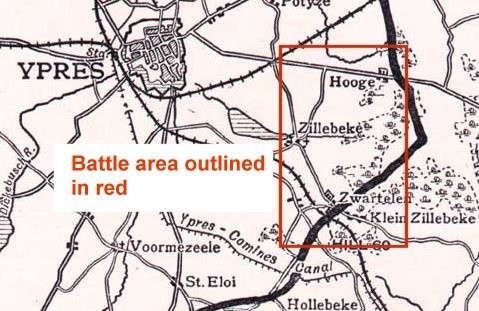
Arthur’s division, alongside the Canadians, fought the Battle of Mount Sorrel in the Ypres salient
from 2nd to 13th June 1916. In the summer of 1916, the Canadian Corps held the southern part of the Ypres salient. The Germans attacked the Canadian lines to secure the last remaining high ground still in British hands. They also sought to divert Allied resources from the large offensive they knew was being prepared in the Somme region. The 3rd Canadian Division was the target of a crushing German bombardment on the morning of 2nd June which killed hundreds. German infantry then swept forward, capturing Canadian positions atMount Sorrel and on two surrounding hills. It is likely that Arthur died in a hastily organized counterattack on 3rd June 1916 (when he was 23 years old and just six months after his marriage to Laura), which ultimately failed. The Battle of Mount Sorrel lasted for almost two weeks and cost the Canadian Corps over 8,000 casualties. Having lost the first two phases of the battle, the Canadians achieved victory in the final operation.
Arthur is buried at the White House Cemetery, St. Jean-Les-Ypres, Belgium. The cemetery, designed by Sir Reginald Blomfield, was begun in March 1915 and used until April 1918 by units holding this part of the line. There are now 1,163 Commonwealth servicemen of the First World War buried or commemorated in this cemetery.
Arthur’s father John was issued with a passport in October 1916, however, it is unclear if this was related to Arthur’s death and whether it would have been possible for him to travel to France during the war.
Arthur’s widow Laura was awarded a pension on his behalf of around 11 shillings a week from the 18th December 1916. She married Arthur’s best man, P.C. Charles Hugh Gilham on the 27th July 1918 at St. Michael’s Church. The certificate of Arthur’s death from the Commonwealth War Graves Commission lists Laura as living at 10 Police Quarters, Berber, AbbeyWood.
Arthur’s father John continued to lead a colourful life. The Bexleyheath Observer reported on the 12th December 1919 that he was found guilty of selling beer at a price above the maximum and fined him £20, plus costs of £7.7s. He eventually retired to Nice, France, having set sail for Marseilles on the Narkunda on the 24th September 1926 (his occupation recorded as a market gardener and his address as Hills Grove, East Wickham) and sold the pub less than a year later to “Beasley” on the 24th June 1927.
John died in Nice on the 8th January 1938. His probate was proved on 11th April 1938 leaving all his estate to Arthur’s two sisters Connie and Mabel. Neither of his sisters had married and they lived together at 24 Upper Bedford Place, London. John’s effects were £18,771.10s.4d. It appears that he made at least some of his money from property development in the area as he had filed building and planning applications in 1903 and 1907 for White Horse Estate and New Streets, Hill Grove Estate.
It is not known what happened to Arthur’s mother Gabriella Charlotte Bond. She is not listed on the ship’s log as travelling to France with his father in 1926 and John’s will (dated 25th July 1931) states that after the death of his wife everything would go to his daughters, which suggests that she was still alive at this point. There are no other people named in this will.
The White Horse Pub was demolished in 1949 and a new one built.
Arthur’s widow Laura was awarded a pension on his behalf of around 11 shillings a week from the 18th December 1916. She married Arthur’s best man, P.C. Charles Hugh Gilham on the 27th July 1918 at St. Michael’s Church. The certificate of Arthur’s death from the Commonwealth War Graves Commission lists Laura as living at 10 Police Quarters, Berber, Abbey Wood.



Commemorated
- East Wickham War Memorial
- East Wickham and Welling War Memorial
- East Wickham and Welling War Memorial Hall
Links
This story has been researched by volunteers. We have taken every effort to ensure its accuracy. If you are related to Arthur Reginald Bond, or if you have any further information, please do get in touch.