


Died: Lost during ‘Operation Demon’ – the evacuation of Allied troops from mainland Greece
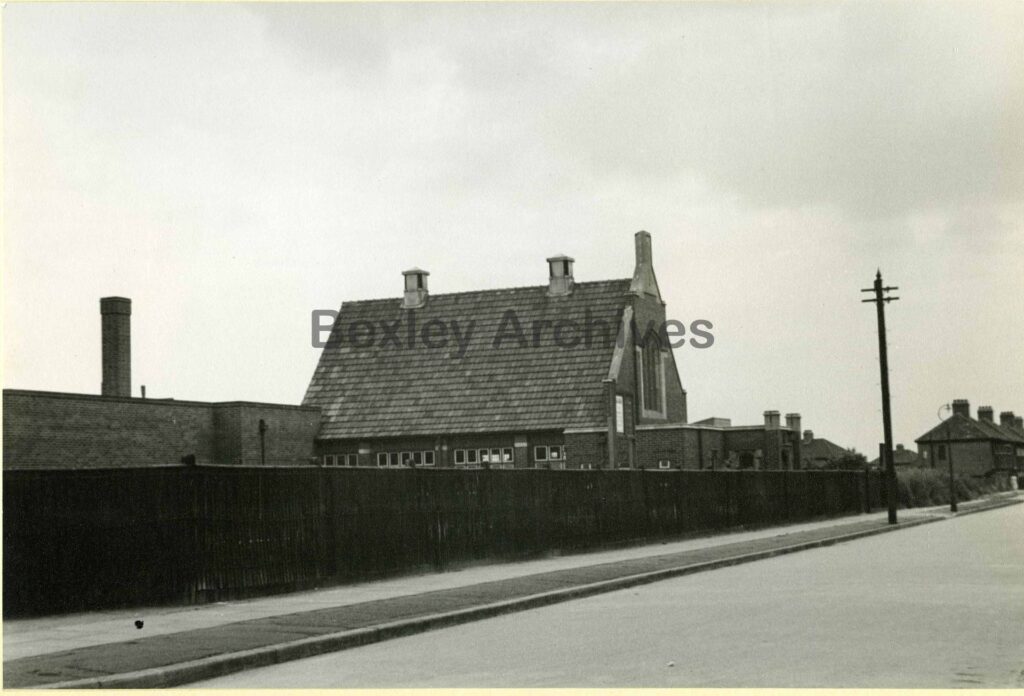
Address / Local links: 50 Axminster Crescent, Welling
Family / Relatives: Son of James F and Elizabeth Aldridge
Other Information: A Builder’s Labourer
James Frederick Aldridge was born on the 7th January 1919, in West Ham, Essex. He was the eldest of seven children and as the first-born son, was given the same name as his father. James Frederick Aldridge, Sr. was also born in West Ham, in 1893. By the age of 17 he was employed as a General Hand Docking worker and went on to serve as a Merchant Seaman during the First World War.
James Sr. married Elizabeth Bell Montgomery in August 1917, at All Hallows Church Poplar. Elizabeth, also known as Bessie, was born in Poplar, East London. Poplar and West Ham were both close to the East India Docks and it is highly likely that their fathers, who were both employed as Boilermakers, worked together at the docks and that James and Elizabeth met through them. Elizabeth was a year younger than James, and by the age of 16 was working as a Confectioner Maker.
James Jr. was born less than two months after the end of the First World War, almost eighteen months after his parents were married. His brother Charles was born just over a year later in February 1920, followed by his sister Elizabeth Bell Eilieen October 1921, and then his second sister Margaret in May 1923. There was a gap of almost four years before James’ next sibling, Eileen Mary, was born, in April 1927. Robert was born just over two years later in July 1929, followed by Donald (known as Archibald) around nineteen months later, in February 1931.
The family doesn’t appear to have a connection to Welling and it is not known exactly when they moved to the area. The births of all the children were registered in West Ham, so the family were living there until at least early 1931, but when the 1939 Register was taken, they were living at 50 Axminster Crescent, Welling. James was by this time twenty years old and he and his father were both employed as Heavy Workers, James Sr. was a Labourer at a Gas Works, whilst James Jr. was a Building Labourer.
Very little is known of James Jr.’s military service, he served as a Private with the Royal Army Ordnance Corps, which was attached to the Royal Artillery and dealt with the supply and maintenance of weaponry, munitions and other military equipment. James Jr. served with 106th Light Anti-Aircraft Regiment, The Lancashire Hussars.
Ironically, although James Jr. didn’t follow in his father’s footsteps and join the Navy during the war, he would die at sea, during the little-known clandestine evacuation of Allied troops from mainland Greece in April 1941, code named Operation Demon. James is believed to have died on the 26th or 27th April 1941. He was just 22 years old.
Operation Demon
The background to Operation Demon is that at the beginning of 1941 Britain decided to provide military aid to Greece, which was facing an ongoing war against Italy and was expecting a German invasion. James’ regiment sailed from Alexandria, Egypt, arriving in Athens in early March 1941. In late April, the Germans had overrun the Greek mainland and the Allies were forced to conduct a fighting withdrawal to the south for evacuation to Crete. Just over 51,000 British, Australian and New Zealand troops were taken from the shores of Greece at night, to avoid the risk of Luftwaffe attacks.
On the night of 26th April, a large number of 106 Regiment soldiers boarded the Dutch ship SS Slamat at Nafplion in Greece. As the ship headed towards Crete it was bombed by German aircraft on the morning of 27th April and caught fire. The ship was abandoned, and most survivors were picked up by either HMS Wryneck or HMS Diamond, both of which were subsequently attacked and sunk a few hours later. Only 50 of the more than 1,000 soldiers and sailors onboard the three ships survived. James is believed to be one of those who died.
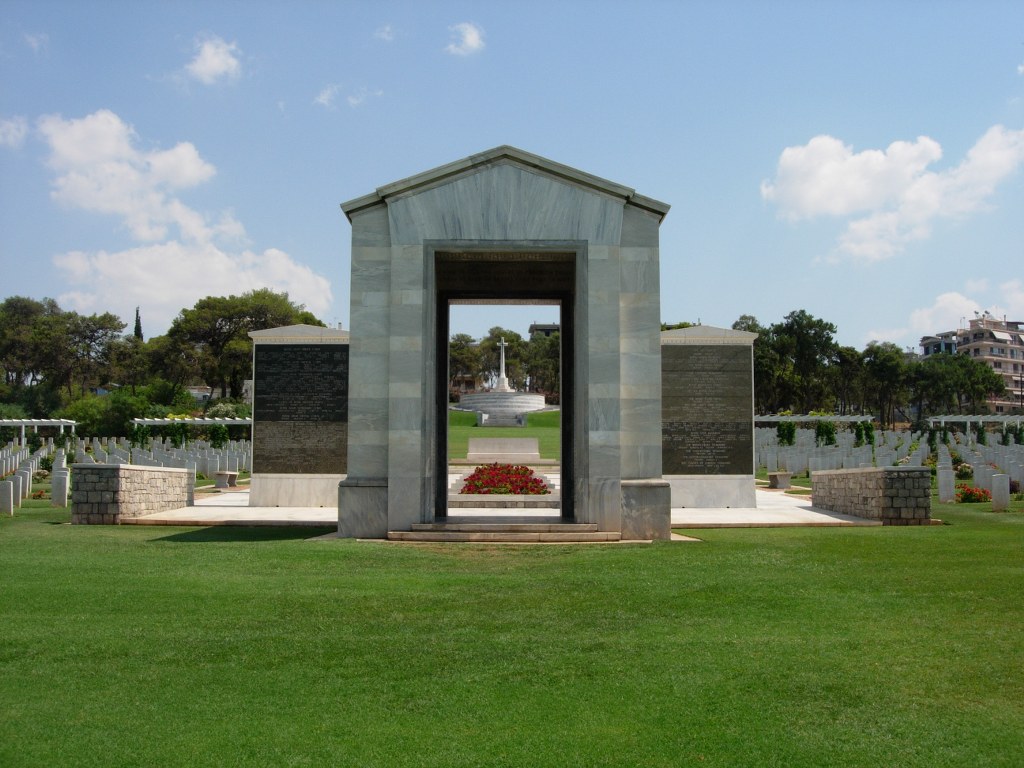
James is commemorated on the Athens Memorial, Greece, and also on the St. Michael’s Church memorial panel.
Tragically for James’ family, his sister Margaret had died shortly before him in April, around a month before her eighteenth birthday. It is highly likely that news of her death would not have reached James before he himself died. Margaret was buried at St. Michael’s Church, East Wickham on the 16th April 1941.
Electoral records show that James’ parents continued to live at 50 Axminster Crescent until at least 1965. His father died in 1976, aged 82. His mother died almost three years later, in 1979, aged 85.
the Athens Memorial, Greece
“The ATHENS MEMORIAL stands within Phaleron War Cemetery and commemorates nearly 3,000 members of the land forces of the Commonwealth who lost their lives during the campaigns in Greece and Crete in 1941 and 1944-1945, in the Dodecanese Islands in 1943-1945 and in Yugoslavia in 1943-1945, and who have no known grave.
The site of what is now PHALERON WAR CEMETERY was chosen originally by the 4th Division as a burial ground for Commonwealth casualties of the Greek Civil War (December 1944-February 1945). Subsequently, the military authorities, in conjunction with the Greek Government and the Army Graves Service, decided that it would be the most suitable site for a Second World War cemetery for the whole mainland of Greece. The 23rd and 24th Graves Registration Units and the 21st and 22nd Australian War Graves Units worked together to bring in graves of the 1941 campaign from the battlefields, temporary military cemeteries and from various civil cemeteries.
There are now 2,028 Commonwealth servicemen of the Second World War buried or commemorated in this cemetery. 596 of the burials are unidentified. Special memorials commemorate casualties known to have been interred in certain groups of graves in the cemetery, but whose individual graves cannot be precisely located within these groups. Other special memorials commemorate casualties re-buried in the cemetery from original graves which, owing to the destruction of local records, could not be identified.
Also within the cemetery is the PHALERON CREMATION MEMORIAL, commemorating 74 men of the army of undivided India who died during the campaigns in Greece and Crete during the Second World War and who were accorded the last rite required by their religion – committal to fire.
In the north-east corner of the cemetery, a plot contains the graves of servicemen and civilians who after serving in the Crimean War, died in Greece, and were buried in the Anglo-French Crimean Cemetery, New Phaleron. The graves were moved in 1966 when that cemetery could no longer be maintained.
The ATHENS MEMORIAL and PHALERON WAR CEMETERY were designed by Louis de Soissons”
Pictured are the Athens Memorial, the sinking of the SS Slamat, and Axminster Crescent from the early 1950s as the Aldridge family would have known it.
…………………………………………………….
If anyone is able to add any extra information, provide more family details, or suggest any corrections, please let us know – also, if anyone has any more photos of this individual listed on our memorials, please get in touch. Thank you.

Commemorated
- St. Michael’s East Wickham Church Memorial Tablet
- Athens Memorial, Greece
This story has been researched by volunteers. We have taken every effort to ensure its accuracy. If you are related to James Frederick Aldridge, or if you have any further information, please do get in touch.