


Died: Killed in Action
Address / Local links: Family at 60 Commondale Road/245 Rustic Avenue Welling
Family / Relatives: Son of Richard and May Florence Aikman (nee Harding), of Portsmouth
Other Information: Born in Portsmouth, emigrated to New Zealand.
A Truck Driver
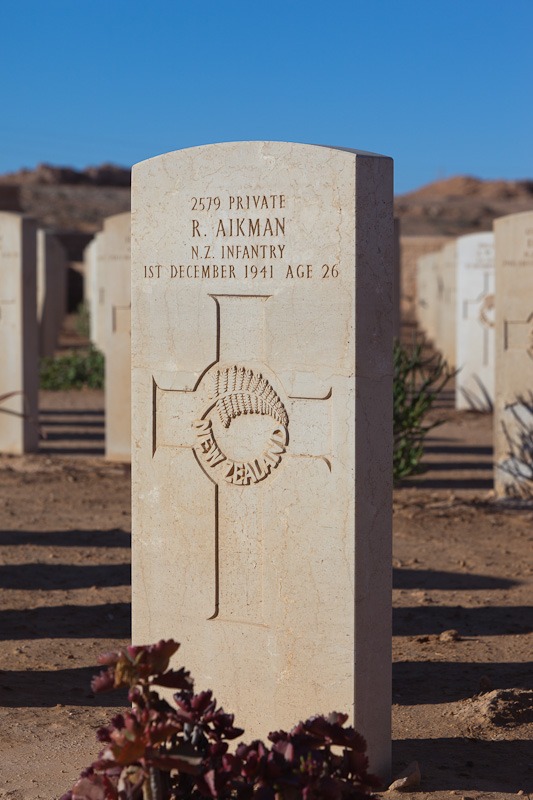
This handsome headstone in faraway Libya marks the resting place of Private Richard Aikman of the New Zealand Infantry. (It is the same war cemetery as another soldier recorded on our Welling website, Reuben Jones).
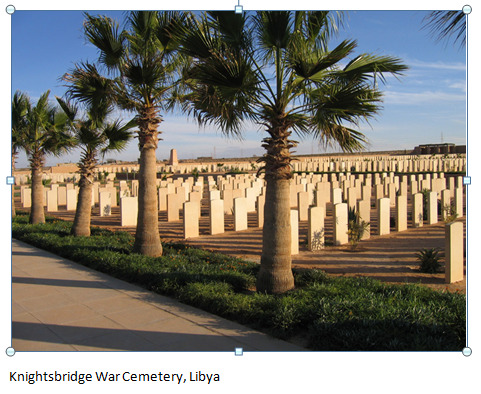
Knightsbridge War Cemetery “is located 750 metres south of the main road from Benghazi to Tobruk, about 25 kilometres west of Tobruk. Standing in open country, with the Cross of Sacrifice set high above the level of the cemetery”.
History information
“The defence against Rommel’s drive across Cyrenaica towards Suez consisted of a number of irregularly spaced strong points or ‘boxes’ linked by deep minefields. Those nearest the Axis forces were held by infantry, while those further back served as reserve static positions and as bases from which the armour could operate. The chief ‘box’, known as Knightsbridge, was round a junction of tracks about 20 kilometres west of Tobruk and 16 kilometres south of Acroma, commanding all the tracks by which supplies came up to the front.
The Eighth Army’s advance fuelling stations and airfields were at Acroma, El Adem, El Duda, Sidi Rezegh and Gambut, while by February 1941, Gazala aerodrome, taken from the Italians early in the campaign, housed two Commonwealth squadrons. Knightsbridge was thus a key position, and the pivot on which the armour manoeuvred during the heavy fighting which commenced in late May 1942. Fierce actions were fought at all these places, and a battlefield cemetery was created at each for the burial of the dead.
The graves of many of those who gave their lives during the campaign in Libya were later gathered into Knightsbridge War Cemetery from the battlefield burial grounds and from scattered desert sites. The men who fought and died with them, but have no known grave, are commemorated on The Alamein Memorial which stands in El Alamein War Cemetery, Egypt.
There are now 3,651 Commonwealth servicemen of the Second World War buried or commemorated in Knightsbridge War Cemetery. 993 of the burials are unidentified and special memorials commemorate a number of casualties known or believed to be buried among them.
There are 18 Non Commonwealth burials here, including 1 Polish soldier, and 1 non world war service burial”.
Richard Aikman was born in February 1915 in Portsmouth, and was the elder of two children, his sister Maisie being born two years later in Devonport.
His father, also Richard Aikman, was born in Glasgow, and joined the Royal Navy in 1898, when he was 18. He served in the Navy until 1910, after which he worked as a Furniture Packer for Pickfords.
In October 1913 he married May Florence Harding, but on the outbreak of the First World War in 1914 he re-joined the Navy, serving for the duration of the war, during which time their two children were born.
May also joined the Armed Forces, serving in the Women’s RAF from 25th April 1918 until 1920. The family then moved to 250 Rustic Avenue, Welling, where Richard Snr worked as a Store Timekeeper in a furniture factory in Woolwich. He subsequently moved to 60 Commondale Road, Welling in the 1930’s, and worked as a window cleaner, before moving to 245 Rustic Avenue, Welling in the 1940’s, to live with his mother-in-law Ruth Lavinia Buckle. (Commondale Road and Rustic Avenue were part of the town’s ‘hutments’ settlement, pictured).
In the meantime, Richard Jnr had emigrated to New Zealand, where he lived in Waitoa, Waikato, and worked as a truck driver.
18th Battalion New Zealand Infantry
In September 1939 he volunteered to join the newly formed 18th Battalion New Zealand Infantry as a Private, and after initial training in New Zealand, the battalion was dispatched to Egypt in 1940, where they underwent further training.
In March 1941 they were posted to Greece, and took part in the Battle of Greece, before being withdrawn to Crete, where they sustained heavy casualties, and were evacuated back to Egypt.
In November 1941 they were assigned to the British Eighth Army, and participated in Operation Crusader in Libya. On 225th November, along with the 20th Battalion New Zealand Infantry, they were tasked with the capture of Belhamed Hill, which was finally achieved with a bayonet charge. They held the hill until 30th November, when they were surrounded by the 15th Panzer Division, and the 20th Battalion was largely destroyed. The 18th Battalion did succeed in evacuating, though it sadly appears that Richard was killed in the action.
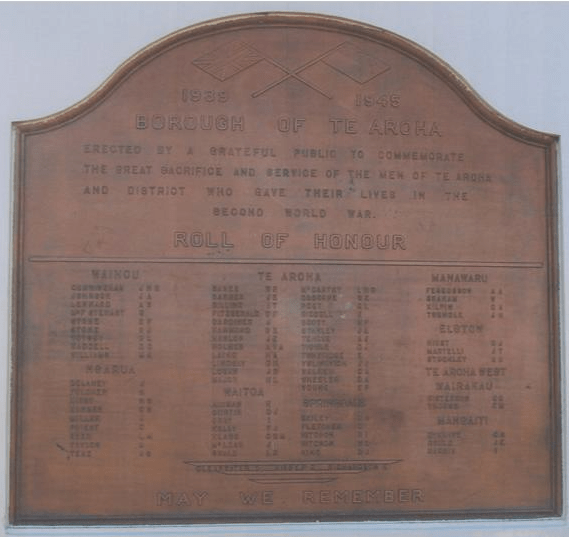
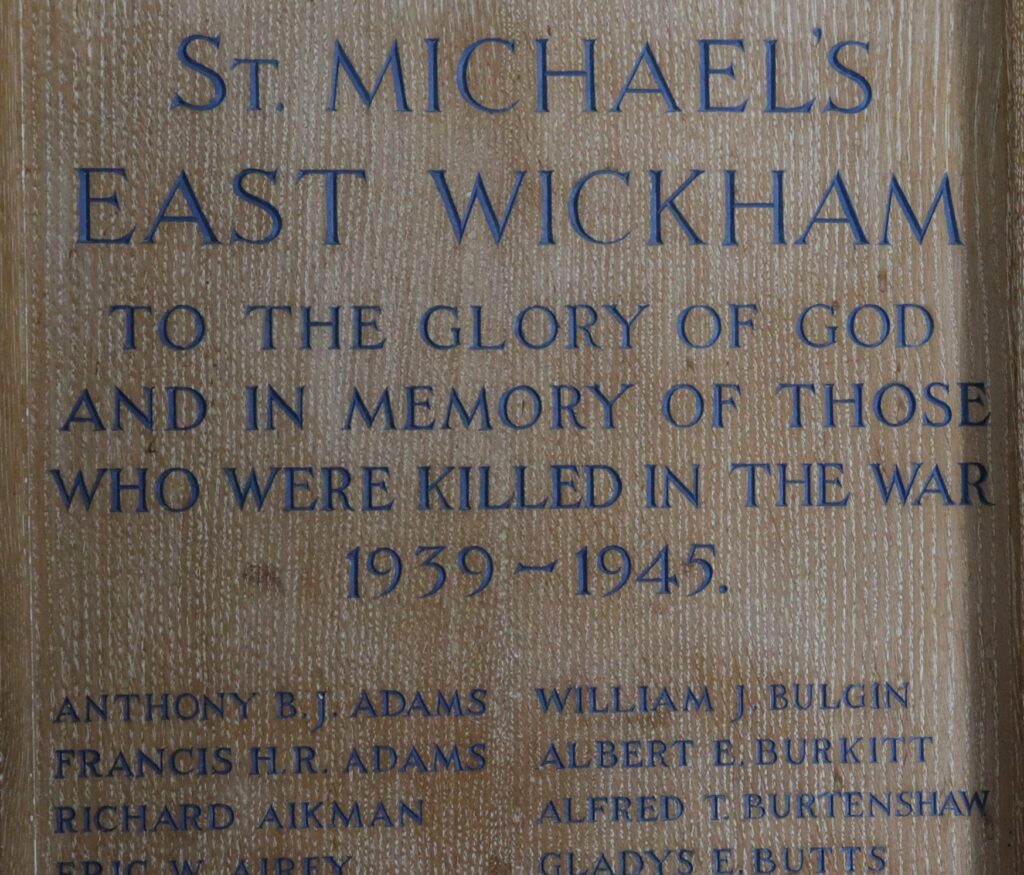
Richard is buried in the Knightsbridge War Cemetery, Acroma, Libya, and is also commemorated on the St. Michael’s East Wickham Church Memorial Tablet, the Borough of Te Aroha, 1939-1945 Memorial, New Zealand, and the Auckland War Memorial Museum, World War II Hall of Memories.
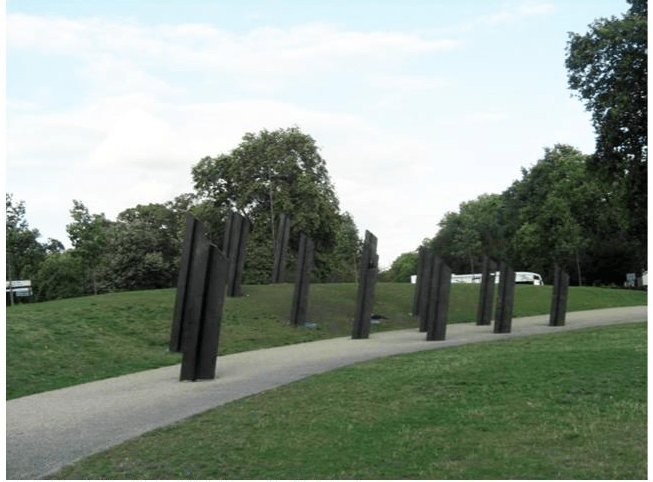
These are all shown in the images below, along with the New Zealand War Memorial Hyde Park, London, which was unveiled in 2006. Also pictured are the Welling hutments, where the Aikman family lived.
…………………………………………………….
If anyone is able to add any extra information, provide more family details, or suggest any corrections, please let us know – also, if anyone has any more photos of this individual listed on our memorials, please get in touch. Thank you.



Commemorated
- St. Michael’s East Wickham Church Memorial Tablet
- Knightsbridge War Cemetery, Libya
Links
This story has been researched by volunteers. We have taken every effort to ensure its accuracy. If you are related to Richard Aikman, or if you have any further information, please do get in touch.