


Address / Local links: 125 Brixham Road, Welling
Family / Relatives: Husband of Alice Divall of Welling
Local Papers / Websites: BHO 5th November 1943
Other Information: A Gas Labourer

We’re fortunate to have this detailed newspaper cutting from the Bexleyheath Observer giving us a few brief details of Charles Divall’s background – he’d joined the army in April 1941 and went overseas that December…”his wife received a post-card from him from Durban but has heard nothing more”…It also tells us that they’d been married for 14 years and had one son…
Before the war he’d been a Gas Labourer for the Commercial Gas Company – a gas company in London that supplied gas from the late 1830s until the mid-20th century…
“The company supplied gas to London, including Stepney and Poplar” which is the area where our researcher discovered more about the Divall family…
Charles Alfred DIVALL, son of Alfred DIVALL (1878-1919) and Jane Ann MURRAY (1877-1956), was born on 10 November 1907 in Plaistow. He was baptised on 6 December 1907 in St Mary the Virgin, Plaistow.
In 1907 he lived in 23 Victoria Road, Plaistow. He appeared in the census in 1911 in 88 Grange Road Plaistow, West Ham. In 1921 he lived in 62 Swaton Road Poplar. In 1930 he lived in 62 Swaton Road Poplar.
He married Alice CLARKE on 27 March 1930 in All Hallows, Bromley By Bow: Devons Road, Tower Hamlets.
In 1939 he was a Gas labourer. He appeared in the census in 1939 in 62 Swaton Road Poplar. Living with Mother Jane & 2 others.
In 1940 Charles was a Gunner in Royal Artillery. He died on 3 March 1942 in Far East. He was buried in 1942 in Jakarta War Cemetery.Charles’s wife was Alice (nee Clarke) – it was through Alice that we assume that Charles’s name was added to our local memorials after the war…
Alice CLARKE, daughter of Daniel CLARKE was born on 9 January 1904. She was a Cardboard box maker. She appeared in the census in 1939 in 62 Swaton Road Poplar. House shared with Mother-in-law & 2 others.
In 1945 Alice lived in 125 Brixham Road. In 1948 she lived in 125 Brixham Road. John E Acaster listed at same address.
In 1952 Alice lived in 28 Danson Lane. John E Acaster also listed at address. In 1995 Alice lived in 257A Singlewell Road, Gravesend. She died on 23 July 1995 in Gravesend.
Their son was Kenneth J DIVALL (1934-1979). Kenneth was born on 10 June 1934. He died on 15 July 1979 in Eynsford.
We have also discovered some details about Charles’ parents, Alfred and Jane Ann;
Alfred DIVALL, son of James DIVALL, was born in 1878 in Peckham. He was a General labourer.
He appeared in the census in 1901 in 23 Victoria Road, West Ham. In 1901 he was a Labourer at bottlers. He married Jane Ann MURRAY on 19 November 1905 in St Mary the Virgin, Plaistow. He appeared in the census in 1911 in 188 Grange Road Plaistow, West Ham. 2 rooms.
Alfred died in 1919.
His wife, (Charles’ mother), Jane Ann, married twice after Alfred’s death…Jane Ann MURRAY, daughter of Charles Stewart MURRAY and Jane Ann ADAMS, was born in 1877 in Poplar. She appeared in the census in 1881 in 71 Guildford Road, Bromley, Poplar. In 1905 she lived in 134 Grange Road, Plaistow. She appeared in the census in 1921 in 62 Swaton Road Poplar. In 1922 she lived in 62 Swaton Road Poplar.
She married Henry Batt HARLEY on 15 April 1922 in All Hallows, Bromley By Bow: Devons Road, Tower Hamlets. She married Alexander HEYMER in 1945 in Poplar.
She died in 1956 in Edmonton.
(It seems that Alfred and Jane had one other child apart from Charles – Jane Alice – who died in 1918 aged 11).
From this we can gather that Charles must have had an unsettled and difficult upbringing?…
His demise came in a cruel fashion in a far distant conflict as one of the now long forgotten ‘Java Gunners’…
Java Gunners
https://www.cofepow.org.uk/armed-forces-stories-list/java-gunners
“The Netherlands East Indies (now Indonesia) comprised the large islands of Java, Sumatra, Dutch Borneo, Celebes and numerous other small islands. By far the most populous island was Java with some sixty million inhabitants. The Islands became Dutch Colonies in the Seventeenth Century and they were overrun and occupied by the Japanese in the first few months of 1942…During the night of 28th February/1st March 1942 a strong Japanese force landed at Eretenwetan on the North Coast of Java and, with tanks, pressed inland. By 10.00 hrs 1st March 1942 they had taken the defences of Kalidjati airfield by surprise and had over-run it. 49 Battery of 48 LAA Regiment RA was destroyed as well as the battery from 6 HAA Regiment operating in an infantry role.
On 2nd March 1942 HQ 16 AA Brigade was reformed to take command of all AA Troops in Java. Major General Sitwell, the GOC British Troops in NEI now had two brigades under his command, 16 AA Brigade and Black Force.Black Force was an ‘ad hoc’ brigade-sized group which was formed in Java in mid-February 1942. It was under the Command of Brigadier A S Blackburn, an Australian, and comprised Australians (2/3 MG Battalion, 2/2 Pioneers, 2/6 Field Company RAE, some RAAMC and RAASC), Americans (1/131st Field Artillery Battalion) and British (‘B’ Squadron of 3rd Hussars and later, RAF Ground Personnel organised as infantry and the Signal Section of 48 LAA Regiment RA.)
During 4th March 1942, amid growing disintegration of the Dutch Forces in Java as a result of strong Japanese pressure, British AA units in Batavia were ordered to concentrate in the Bandoeng area and so 239 Battery of 77 HAA Regiment RA and 242 Battery of 48 LAA Regiment RA moved accordingly…
As the situation grew more confused, 16 AA Brigade units were told to concentrate on Tasikmalaja airfield as a prerequisite for a kind of last ditch ‘wolf’s lair’ type defence…”
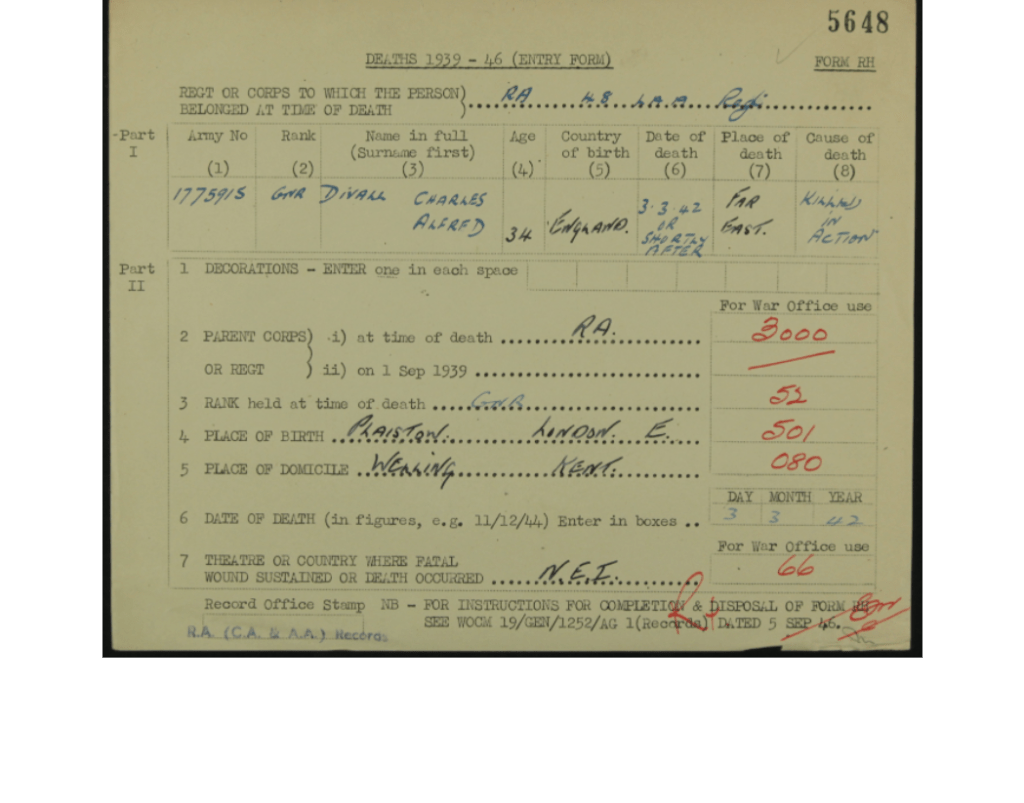
It was into this confused fighting that Charles Divalls’ military records state; Death 3 March 1942 “or shortly thereafter”.
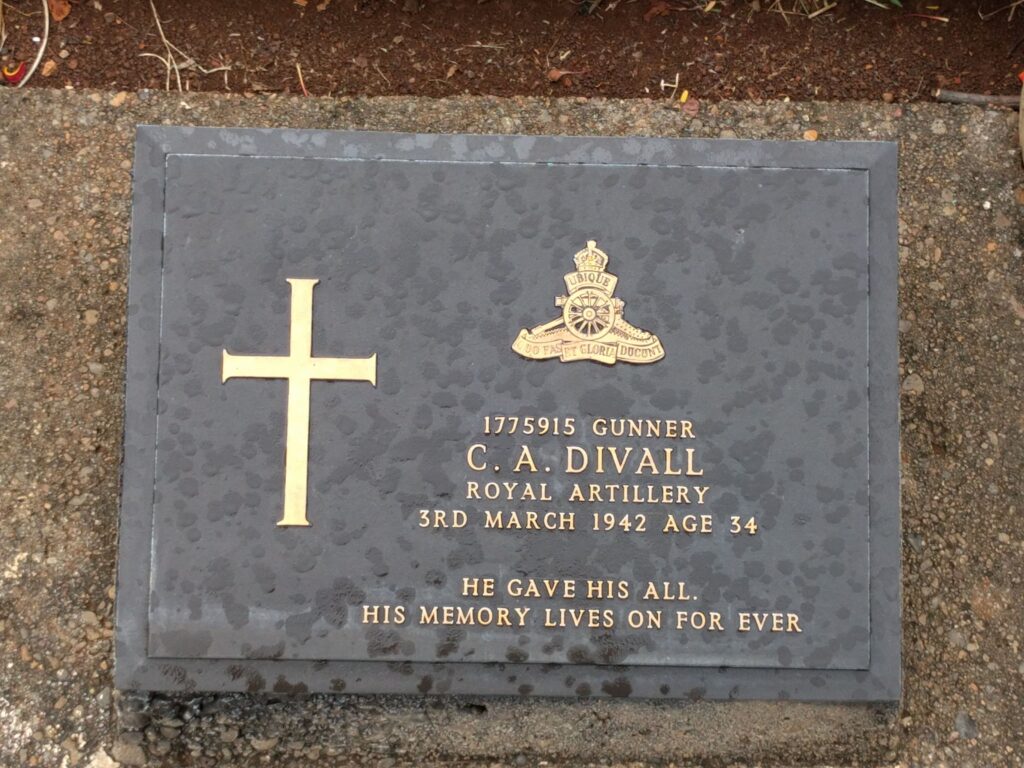
Charles was buried in the Jakarta War Cemetery, Indonesia
“Jakarta (Djakarta) lies on the north-west coast of the island of Java. Jakarta War Cemetery is in the suburb of Menteng Pulo, 11 kilometres from the city centre.
History information
Jakarta, the capital of the Republic of Indonesia, lies on the north-west coast of the island of Java. It was the administrative capital of the former Netherlands East Indies and was known as Batavia, the name used in the records of the 1939-1945 War. Batavia was the port by which thousands of British and Commonwealth servicemen entered Java in February 1942 from Singapore and Sumatra, shortly before the Japanese invasion of the island. It was defended by Nos. 232 and 605 (Fighter) Squadrons from Tjililitan airfield, a few miles distant. Although greatly outnumbered and dwindling in strength, the fighters remained in action in defence of the capital from 17th-27th February. The 77th Heavy Anti-Aircraft Regiment was also employed in Batavia’s defence. On 25th February H.M.S. Exeter, Electra, Encounter and Jupiter and H.M.A.S Perth sailed from Batavia to join the Eastern Striking Force at Sourabaya before meeting the Japanese in the Battle of the Java Sea. On 1st March the Japanese landed near Batavia, by the 4th the Dutch had ordered its evacuation, and on the 5th the Japanese occupied the town. Most of the Allied prisoners of war captured in Java were later concentrated in a number of prison camps around Batavia, one of the largest being “Bicycle Camp”, so named because it had been the barracks of a Dutch cycle battalion. The camp held among its first prisoners 300 survivors of H.M.A.S. Perth, and 250 soldiers of the 2/15th Punjab Regiment who had fought in Borneo. In 1961 at the request of the Indonesian Government, the Commonwealth dead from the Netherlands Field of Honour at Sourabaya, and from those at Palembang, Medan and Muntok in Sumatra, were brought into the cemetery, which already contained 474 Commonwealth war graves. Additional land was acquired to accommodate all the graves, and the total number of burials was increased to over 1,000. Jakarta War Cemetery therefore contains the graves of many who died in defence of Java and Sumatra during the swift Japanese advance in 1942 and many others who perished afterwards as prisoners of war. Among the dead were sailors who fought in the Battle of the Java Sea, soldiers of “Blackforce” including a number of Australians whose graves lie together in plot 6, and airmen who died in flying battle and airfield defence.
The cemetery is entered on its northern side by a short flight of steps leading into a memorial building. This contains bronze plaques which contain the names of the 58 identified officers and men who now lie buried at Ancol. Two main grass avenues cross the site, one running north-south and one east-west, and the Cross of Sacrifice stands at their intersection. The graves of members of the forces of undivided India lie on a terrace in the southern part of the cemetery. Here an Indian Forces monument has been set up; it is a stone pillar crowned by a sculptured wreath and bearing wreaths on two sides, with “INDIA” inscribed below one and “PAKISTAN” below the other.
The graves are marked by bronze plaques set in concrete pedestals. The cemetery is covered with turf and planted with many colourful sub-tropical trees and shrubs.
The architect of this cemetery was Ralph Hobday O.B.E. who was the Senior Architect of the Commission”
Pictured are Charles’ casualty record, the Jakarta War Cemetery, Indonesia, and Charles’ burial place.
……………………………………………………. If anyone is able to add any extra information, provide more family details, or suggest any corrections, please let us know – also, if anyone has any more photos of this individual listed on our memorials, please get in touch. Thank you.

Commemorated
- St. Michael’s East Wickham Church Memorial Tablet
- Jakarta War Cemetery, Indonesia
This story has been researched by volunteers. We have taken every effort to ensure its accuracy. If you are related to Charles Alfred Divall, or if you have any further information, please do get in touch.