


Stanley Hull was born in Woolwich on 5 March 1894. His grandfather was Francis Hull, born in Kerry in Ireland in 1819 and who emigrated to England, settling in Woolwich where he married Stanley’s grandmother, Ann Wilkinson.
Stanley’s father, William, was born in 1851, also in Woolwich, marrying Stanley’s mother, Alice Gleed, from Battersea in about 1883. The 1891 census records William and Alice and their first born children, Henry W and Violet, living at 15 Rectory [Grove] in Woolwich where William was a furniture dealer.
By the time of the 1901 census, the family had moved to 48 St Mary Street in Woolwich. Stanley was 7 and had six brothers and sisters: William, Violet, Albert who were all older and Elsie, Courtney Gilbert and Gladys who were all younger. The census records William the elder as being a furniture shopkeeper, working for himself.
The 1911 census records what was left of the family living at 32 High Street, Welling. Five of the children are shown living with William and Alice (who is referred to as Clara) and it’s stated that all together they had 12 children, 7 of whom died. William is shown as being a Furniture Shopkeeper. Although by this time Stanley is 16, he is not shown as being in work.
On 22 September 1916, Stanley enlisted in the Army at Woolwich, assigned to the 2/8 Battalion, Durham Light Infantry. The enrolment form stated that he was 5 foot, 10 inches tall, a skilled labourer and single. His age was stated as being 22 years, 120 days. This would mean that he was born in March 1894 and not 1895 as appears in later records. His health was classed as B1. This meant that he was considered able to march 5 miles, see to shoot and hear well. It also meant he was fit enough for Garrison Service Abroad. However, following inoculations, on 31 October 1916, he was reclassified as A1 – fit for general service and able to march, see to shoot, hear well and stand active service conditions.
On Friday 15 June 1917, probably the day he was posted to France, Stanley signed a will which stated:
“In the event of my death I give £15 to my mother of 32 High Street Welling Kent. and in the event of her death my sister Gladys of the above address, and I give the remaining of my property to my sister Mrs Karmel & Gold Watch and Chain to my brother my motor bike”.
Signature: S A Hull
Rank and Regiment: Pte 302559 2/8 Durham LI D Coy
Date: Friday 15 June 1917”
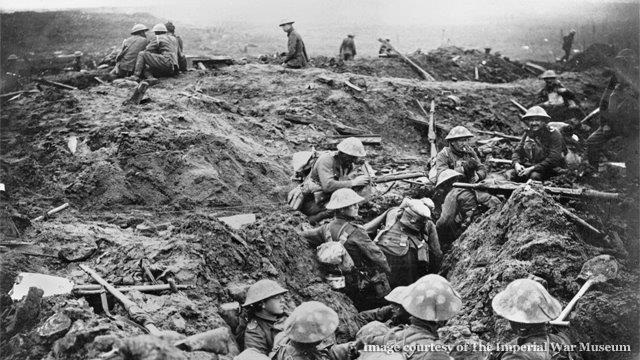
On 5 July 1917, he was posted to the 13th(Service) Battalion Durham Light Infantry. The 13th Battalion was at this point serving on the Ypres salient and the third battle of Ypres was in full swing. Field Marshall Haig had been frustrated that British attacks on the salient towards the end of August had been unproductive. Command for the offensive accordingly passed from General’s Gough to Plumer. Much of September was taken up with preparations for a new assault, including a huge artillery barrage which began on 31 August.
Thoroughly wet by overnight rain, on the early morning of 20 September, 65,000 British and Commonwealth troops advanced on an eight mile front, the 13th DLI among them. The battalion war diary records that A and C Companies were in the firing line, B Company in close support and D Company, Stanley’s Company, in reserve. A and C Companies reached their objectives and dug in. D Company brought up materials to assist with the consolidation of the position.
On 21 September, the war diary states that the battalion remained in the line all day and endured heavy enemy counter attacks. A Company was withdrawn to Battalion HQ and D Company went into the line. In total, over the two days, the battalion lost 9 officers and 200 other ranks, killed wounded or missing.
Unfortunately, Stanley Hull was one of those killed on the 21st. His Field Service Report states simply that he was Killed in Action “In the Field” in France. From what we know of the action, it is reasonable to assume he died attempting to hold the gains of the previous day against one of the enemy counter attacks. He has no known grave and his name is recorded on Tyne Cot Cemetery memorial to the missing Panel 128 to 131 and 162 and 162A. He was one of nearly 21,000 British and Commonwealth casualties suffered between 20 and 25 September at the Battle of the Menin Road Ridge.
Stanley’s home address on the Commonwealth War Graves Commission website is stated as being 14 Bethel Road, Welling. However, an internal military memorandum dated 3 April 1918, directed that Stanley’s personal effects, including his service medals, be delivered to Mrs Violet Karmel of 32 High Street, Welling. Violet was Stanley’s sister. Indeed a declaration signed by Stanley’s brother, Albert on 31 August 1918, states that the family stilled lived at 32 High Street so it’s not clear where the 14 Bethel Street address came from.
His death was simply reported in the local Chronicle and District Times on 19th October 1917:
Mr. and Mrs. Hull, of 32, High-street, Welling, have received the sad news that their son, Private Stanley Hull, was killed in action on September 21, at the age of 21. Private Hull, who was well known at Welling, was employed at the Woolwich Arsenal before the war. He had been in the Army twelve months.
One can only hope that Stanley’s gold watch & chain, together with his motor bike, reached his desired recipients.

Commemorated
Links
This story has been researched by volunteers. We have taken every effort to ensure its accuracy. If you are related to Stanley Alexander Hull, or if you have any further information, please do get in touch.