


Ernest (registered as William Ernest) Steward was born on 26th July 1885, the eldest son of William Alfred and Eliza, née Inge. His father was a gardener from Ipswich in Suffolk (1860-1929) and his mother was from Little Yeldham in Essex, where the couple had married in 1884.
The couple settled in the Woolwich/Greenwich area. Their two first sons were born in Charlton, Ernest being followed by Alfred Bertie in 1887. Another son followed 2 years later in Greenwich, Albert Edward (1889/90). At the time of the 1891 census, they were living at 6 Sun Garden Cottages in Old Dover Road in Greenwich.
They moved after that to Plumstead where Robert Ambrose was born in 1893 and John Leonard in 1897 followed at last by a girl named Kate, born in 1899. That same year, one of the boys, Albert, died aged 9. It must have been a terrible time for the family. The 1901 census shows them at 56 Red Lion Lane, near Shooters Hill. Soon after they moved again, this time to the Welling area where another of their sons, John Leonard, died aged 4 (in 1902).
The year 1909 was another sad year for the family: Eliza the mother died. She was only 51.
The father William Alfred became a lodger, with his 2 younger children, Robert and Kate, to James and Amy Lampkin in Glengall Cottages in Shooters Hill. His elder sons had both joined the forces by 1911, Alfred Bertie had joined the Army and is recorded in the 1st battalion of the King’s Own (Royal Lancaster Regiment), in Woolwich, while William Ernest had joined the Royal Navy and was in Devonport, on board HMS Onyx, a former torpedo gunboat, transformed into a submarine depot ship in 1907.
William Ernest [W. G. Steward on Ancestry!) had the rank of Leading Seaman. William Ernest’s service number was 214883 Devonport.
He had reached the rank of petty officer at the time of his death on 31st May 1916 on board HMS Indefatigable. This ship was a battle cruiser of Admiral Beatty’s fleet, part of the 2nd Cruiser Squadron. On 31st May 1916, the ship was engaged in a gun duel with a German ship, Von der Tann. At 16.03 she was hit by a heavy shell amidships which caused her to blow up and sink. She was one of several ships that suffered the same fate in what was called the Battle of Jutland. Admiral Beatty remarked that” there seems to be something wrong with our b….y ships today.” There were only three survivors. 1,017 members of the crew of HMS Indefatigable died that day.
Just over one month later, William’s younger brother Alfred Steward was killed in the Somme.
The death of his eldest sons just within one month and one day must have been terrible for the father. Of the 5 sons he fathered, William Alfred lost 4, and not as babies but either as young children of school age (in 1899, Albert aged 9, and in 1902, John Leonard aged 4) or as grown up men doing their duty for King and country (both died in great battles of WWI). He died in 1929, at the age of 68.
The War Graves Roll of the Royal Navy, as indexed online, gives his birthplace as “Charlton, Dover, Kent” (sic), which could be a mistake for Dover Road. William Ernest is not only commemorated like his brother Ernest on the St. John‘s Memorial in Welling and on the East Wickham one, but also on the Plymouth Naval Memorial.
Transcripts to images from The National Archive http://www.nationalarchives.gov.uk
Transcript of Navy Telegram Reporting the Loss of the Indefatigable 1916 (ADM 137/1642)
“TELEGRAM No. 995
From C. in C, Grand Fleet Date 2.6.16
To Admiralty Recd – 2.15 a.m. 3.6.16
995 Your 465 and my 994
At 3.50 p.m. on 31st May V.A.C. Battle Cruiser Fleet reported himself engaged with enemy Battle Cruisers steering about E.S.E. enemy to the Northward. INDEFATIGABLE was sunk 10 minutes after commencement of action by shell exploding in Magazine. QUEEN MARY half an hour later probably same cause. Subsequent to this 5th B.Sq which had been in the rear got into action and shortly afterwards enemy’s Battle Fleet which had been reported as in sight by 2nd.Lt.Cr.Sq. appeared and V.A. B.C. fleet turned round followed by 5th B.Sq. I had send 3rd.B.C.Sq. which was 20 miles ahead of me, to support B.C.Fleet on learning of the enemy being in sight, the Battle Fleet being at this time over 30 minutes to the North steering for the scene of action at 20 knots. 3rd.B.C.Sq. apparently joined B.C.F. about 5.0 p.m. and INVINCIBLE was blown up either by shell in magazine or mine or torpedo. At 5.44 p.m. Cruisers and Lt.Cruisers ahead of Battle Fleet were seen to be altering courses to port Battle Fleet’s course then being S.E.by South. The weather was very misty, visibility being about six miles to the westward and less to the eastward.”Glossary – VAC : Vice Admiral Commanding. ESE : East, South East. B Sq : Battleship Squadron. Lt Cr Sq : Light Cruiser Squadron. BC : Battle Cruiser. VA : Vice Admiral. BC Sq : Battle Cruiser Squadron. BCF : Battle Cruiser Formation. Lt : Light. SE : South East
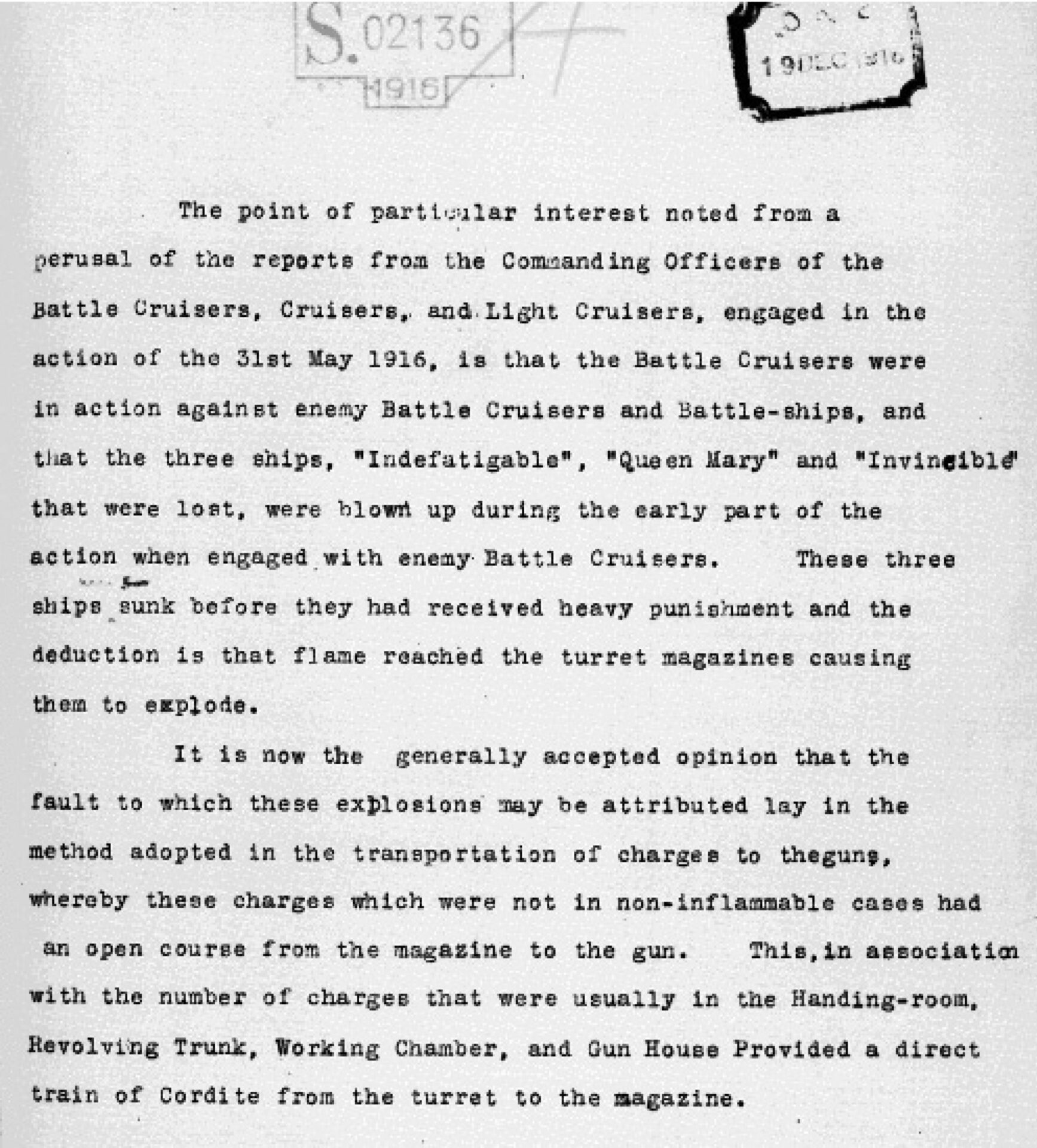
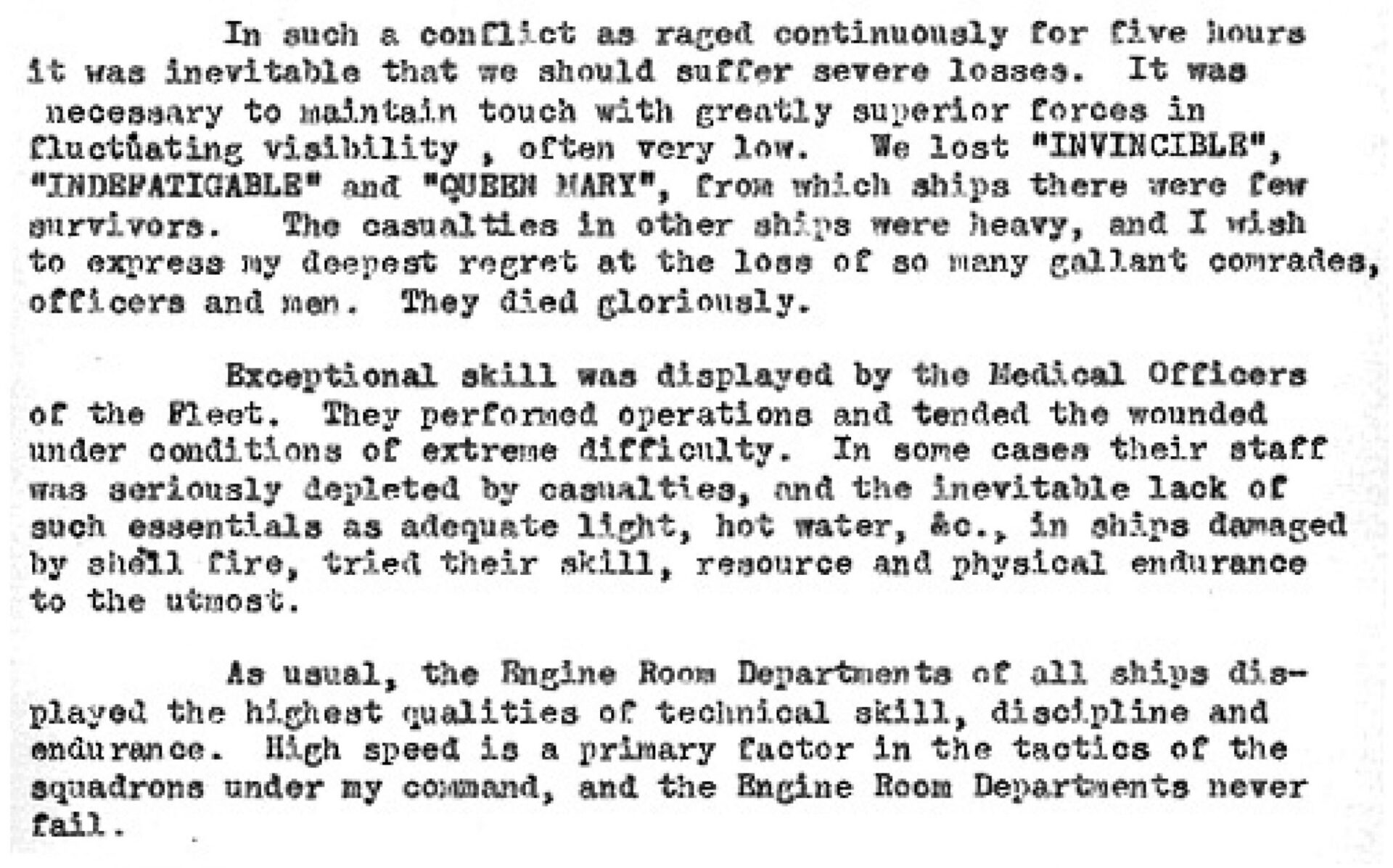
Transcript of A Public Statement Made by the Navy on the Loss of the Indefatigable 1916 (ADM 137/301)
“In such a conflict as raged continuously for five hours it was inevitable that we should suffer severe losses. It was necessary to maintain touch with greatly superior forces I fluctuating visibility, often very low. We lost “INVINCIBLE”, “INDEFATIGABLE” and “QUEEN MARY”, from which ships there were few survivors. The casualties in other ships were heavy, and I wish to express my deepest regret at the loss of so many gallant comrades, officers and men. They died gloriously. Exceptional skill was displayed by the Medical Officers of the Fleet. They performed operations and tended the wounded under conditions of extreme difficulty. In some cases their staff was seriously depleted by casualties, and the inevitable lack of such essentials as adequate light, hot water, &c., in ships damaged by shell fire, tried their skill, resource and physical endurance to the utmost. As usual, the Engine Room Departments of all shops displayed the highest qualities of technical skill, discipline and endurance. High speed is a primary factor in the tactics of the squadrons under my command, and the Engine Room Departments never fail.”
Transcript of Private Navy Report on the Loss of the Indefatigable 1916 (ADM 1/8477/308)
“The point of particular interest noted from a perusal of the reports from the Commanding Officers of the Battle Cruisers, and Light Cruisers, engaged in the action of the 31st May 1916, is that the Battle Cruisers were in action against enemy Battle Cruisers and Battle-ships, and that the three ships, “Indefatigable”, “Queen Mary” and “Invincible” that were lost, were blown up during the early part of the action when engaged with enemy Battle Cruisers. These three ships sunk before they had received heavy punishment and the deduction is that flame reached the turret magazines causing them to explode.

Commemorated
- East Wickham War Memorial
- East Wickham and Welling War Memorial Hall
- Welling War Memorial
- Plymouth Naval Memorial
Links
This story has been researched by volunteers. We have taken every effort to ensure its accuracy. If you are related to Ernest (William Ernest) Steward, or if you have any further information, please do get in touch.