


Raymond Tritton Storer was born in early 1894 and was the youngest of six children. His father, Henry Norris Storer, was around 50 years old when he was born and his mother, Ellen Eliza (nee Tritton) 30. Raymond’s grandfather had founded the Belle Grove nursery, which Raymond’s father and uncle took over on his death. At the start of the 20th century Raymond’s uncle started his own nursery in Bexleyheath and Raymond’s father was left to run the business In 1901 they family were living at 61 Belle Grove. By 1911 the family were living at premises of Belle Grove Nursery (possibly 61 Belle Grove).
Raymond was educated at Hope Lodge, Welling and Roan School, Greenwich, and on leaving the latter entered the employ of Mr. V. A. Little, Diamond Merchant. He also worked as a telegraphist clerk for the Post Office.
Raymond volunteered at the outbreak of war and joined the 1/5th (City of London) Battalion (Rifles) on 31 August 1914, service number 237. From the beginning of that month the Brigade was stationed at Bunhill as part of the 2nd London Brigade of the 1st London Division, and then moved to Bisley and then Crowborough, Sussex.
The Bexleyheath and Bexley Observer article 4 December 1914: “The former Scoutmaster of the 1st Welling Troop of Boy Scouts, Raymond T. Storer, has joined the London Rifle Brigade and is now finishing his training at Haywards Heath, Sussex, prior to going on foreign service. Writing home recently he states that the Brigade attended a Sunday Church Parade and completely filled the church, the usual service having to be held later. He adds: The country here is simply lovely. It is utterly impossible to describe the scenes we see, so beautiful are they. We all look upon what we are doing as a holiday, a delightful one at that. I am enjoying myself. The open air life must have a beneficial effect upon our health. It is stated we shall be here for two months.”
However by the time the piece was published in the 4 December edition, the Brigade was already mobilised for war and embarked for France leaving with the 1st London Division arriving at Havre in early November. They joined the 11th Brigade of the 4th Division on 17 November 1914. The London Rifle Brigade had already seen action in battles on the Western Front including Le Cateau, The Marne, Aisne, Messines and the first battle of Ypres. Raymond, according to a contemporary report sailed for France himself on his birthday, which was in January.
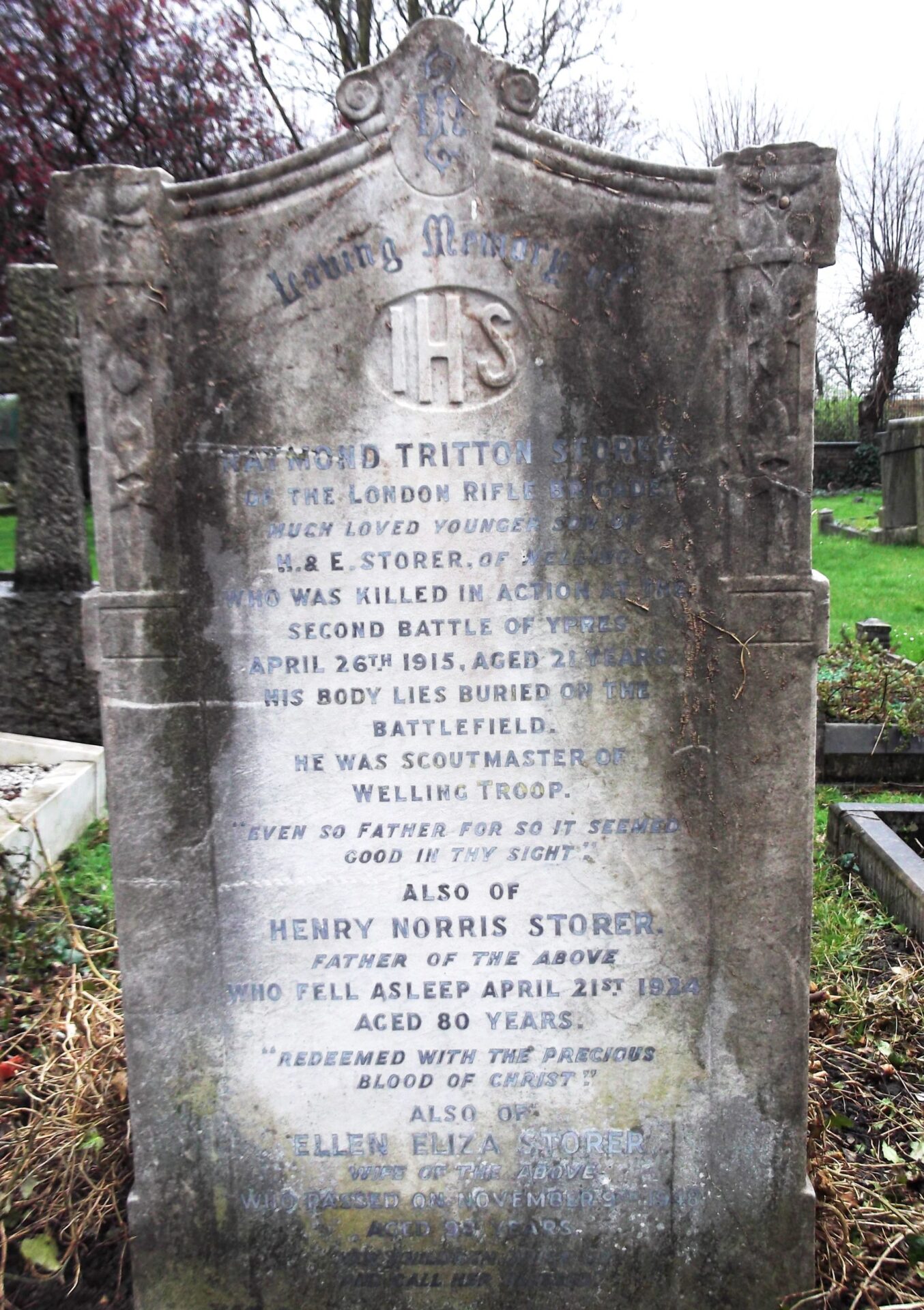
Raymond was killed in action at the 2nd Battle of Ypres and is remembered on the famous Menin Gate Memorial in the Belgian town. He was only 21 years old when he died, but he had already made his mark back at home by founding the 1st Welling Scout Troop.
This is the text from the letter to Raymond’s parents informing them of his death, copied from the original (not available)
“Cromer, May 30 – 15
Dear SirPte. R. T. Storer
In reply to yours I regret to say that owing to the loss by sickness? casualties of 120 of the 180 men in the Company, all kits of the wounded and killed were discarded as many wounded had to be carried on stretchers so Private Storer’s watch and other effects were not recovered. I might say that kits of surviving officers had to be left behind.
Unfortunately there is no one in France who can give an account of your brother-in-law’s death other than what you know, for all the men with him were afterwards killed or wounded. With all the indescribable confusion of a modern battle bombardment, with men in trenches some distance apart it is quite impossible to know exactly the doings of any one man. At least you will have the satisfaction of knowing that Private Storer met his death swiftly with a Battalion that has been highly praised by many generals for the fine stand it made and the work it did, and they had been buried in a soldier’s grave on the battlefield – a fine end in their service.
Please give my good wishes to the dear little chaps in Welling who wrote so nicely to their Scoutmaster – they did not put addresses on their letters and I think I should also have made time somehow to write to them.
I have a schoolboy of my own & its fine to see the way they are doing their little bit for the dear old country of ours.
Please convey my sincere sympathies with the parents of Private Storer and accept the same from.
Yours truly (Major) Addison DennyP.S. Just off south, Aire? Our lines of communication.”
Local Newspaper cutting.
“IN MEMORIAM. STORER – In loving memory of our dear boy, Raymond Tritton Storer, who was killed in action at the second battle of Ypres, April 26th 1915, aged 21. He was Scoutmaster and founder of the 1st Welling Troop of B.P. Boy Scouts.”
Entry in the Sidcup & District Local Association of Boy Scouts – Third Annual Budget (November 1917)
“Private RAYMOND STORER
London Rifles Brigade
(1st Welling Troop)The death of SM (Scout Master) Raymond Storer is a loss not only to his family and his Troop, but to the whole of the Scout movement, as his life was so wrapped up in it that he would not have hesitated until every boy in the locality was a Scout, and his Troop had reached the summit of efficiency. From the time he started the Troop in March 1913, until the date of his enlistment in the Army he gave up practically the whole of his spare time to the interests of the scouts. The management off the Troop was all uphill work, full of obstacles and difficulties, but undaunted by such conditions he worked hard and without assistance for a long time. Then help came and the affairs of the Troop were beginning to get shipshape, when he was drawn away by the call of his country – duty always coming first. On his 21st birthday he sailed for France and in the 2nd Battle of Ypres, he met the fate of a brave soldier.”
Obituary copied and supplied by a family member (original source unknown)
“STORER, RAYMOND TITTON, Private, No.237, 5th Battn, (London Rifle Brigade) ‘The London Regt. (T.F.), yrs of Henry Norris Storer, of Belle Grove, Welling, Kent, Market Gardener and Fruit Grower, by his wife, Ellen Eliza, daughter of William Rush Tritton; b. Welling, 16 Feb 1894; educ. Hope Lodge, Welling and Roan School, Greenwich, and on leaving the latter entered the employ of Mr. V. A. Little, Diamond Merchant. On the outbreak of war he volunteered for foreign service, and joined the London Rifle Brigade, 31 Aug. 1914, and after six months’ training at Haywards Heath and Crowborough, sailed for France on his twenty-first birthday. They were sent up to the trenches, and he was killed two months later at the second Battle of Ypres 26 April, 1915. It was on this occasion that a General, speaking of the London Rifle Brigade, remarked that he had never seen a finer regiment. Storer was buried at Fortuin; unm.”
His background
This Obituary for his father – Mr H N Storer – who died in 1924 gives contemporary insight into Raymond’s background.
“We regret to record the death of Mr Henry Norris Storer who passed away at Belle-grove, Welling on Easter Monday. Mr Storer, one of the oldest and most esteemed residents of the district, was in his 81st year. He died in the house in which he was born.
Mr. Storer belonged to one of the oldest families of horticulturalists on the Heath. His father started the nursery at Belle-grove, Welling, of which he subsequently became proprietor in 1835. After the death of the founder of the business the nursery was carried on by Mr. Henry Storer, and his brother, Mr. John Storer, but the partnership was dissolved about 20 years ago, when Mr. John Storer, who died last September, started his nursery in Bexley Heath.
Mr. Henry Storer was a well-known figure in the Borough Market and Covent Garden, indeed, he was the father of Covent Garden Market.
He was a man of strong religious convictions, and 60 years ago, along with his brother, the late Mr. John Storer, and the late Mr. Peters, initiated Sunday School teaching for children in Welling. In those days classes were held at nine o’clock in the morning as well as in the afternoon, and the conditions were very primitive, the first Sunday School being held in the coach house at Hope Lodge. As is usual with all new movements, the purpose of the first Sunday School was misunderstood. There was an outbreak of rowdyism among the rougher element of the population, and on occasions the door of the coach house was bombarded with brickbats, but this was only a temporary phase, and the Sunday School soon became a source of great blessing to the district.
Mr. Storer in his earlier days attended the Independent Chapel (known as Providence Chapel) in Danson Lane, but afterwards became associated with the Iron Kirk (The Iron Church which originally stood at Welling Corner, now St John’s, Welling), on its erection by Mr. and Mrs. Bean, in the ministry of the Rev. E Raynor, who recently retired after being clergyman at the church for nearly 40 years.
Mr. Storer is survived by his widow, his eldest son, and four daughters. The eldest son, Mr. Norris Storer, is Chief Officer of the Welling Fire Brigade. His second son Mr. Raymond T Storer, who was the first Scoutmaster of the 1st Welling Troop of Boy Scouts, was killed in the war in 1915.”
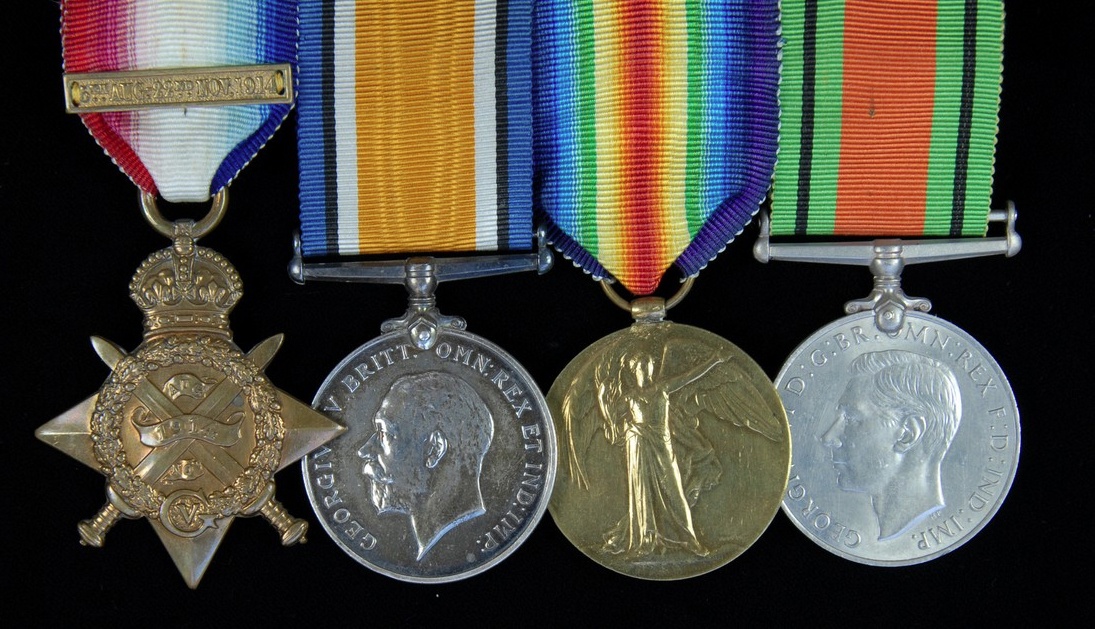
Raymond Storer’s medal set was auctioned at Spink’s in Autumn 2014 – Orders, Decorations, Campaign Medals and Militaria Auction. If you are in possession of these medals, the Trust would be interested in talking to you about them. Please contact us at heritage@ewt.org.uk. Thank you.



This article is still being researched and will be updated in due course.
Commemorated
This story has been researched by volunteers. We have taken every effort to ensure its accuracy. If you are related to Raymond Tritton Storer, or if you have any further information, please do get in touch.