


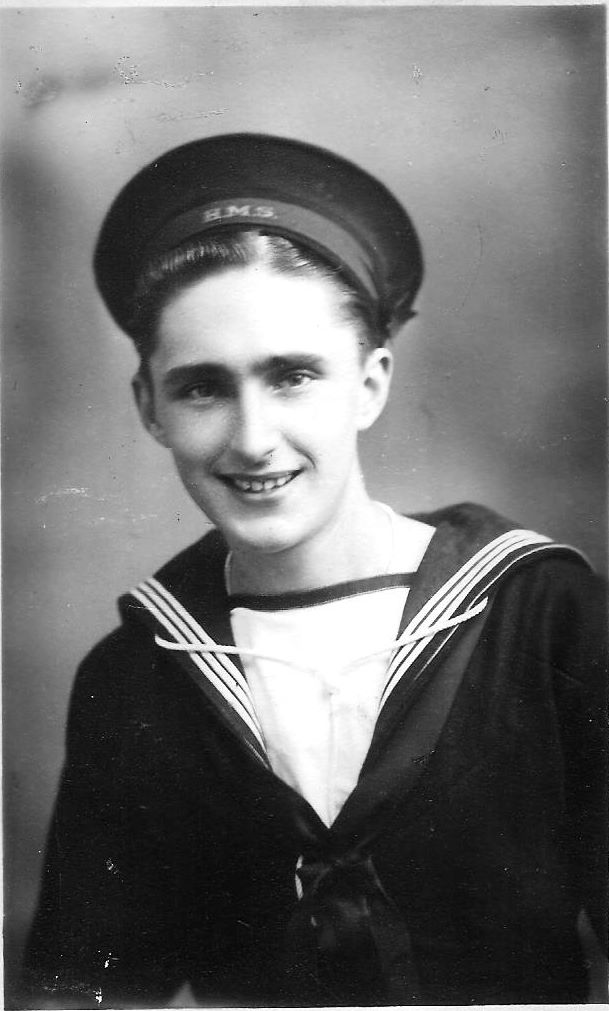
Died: HMS Egret sunk by a Henschel glide bomb attack from a Dornier Do 217 in the Bay of Biscay
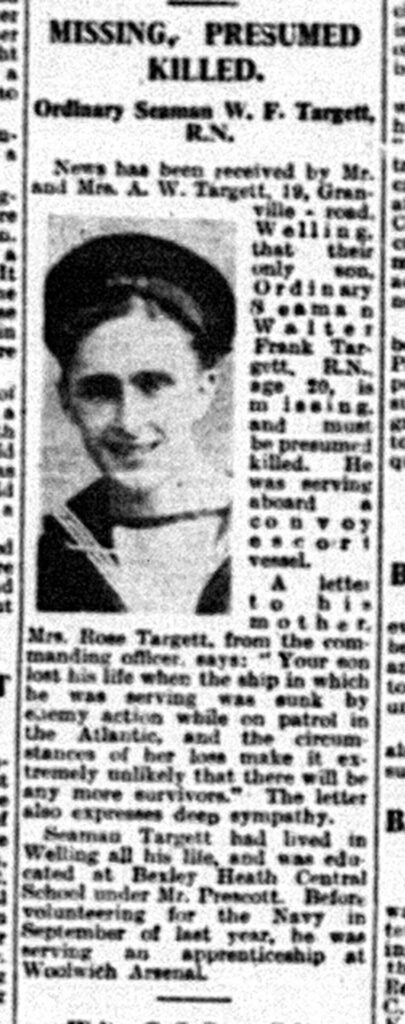
Address / Local links: 19 Granville Road, Welling
Family / Relatives: Son of Mr and Mrs Arthur Walter and Rose Targett, of Welling
Local Papers / Websites: BHO 5th November 1943
Other Information: Bexleyheath Central school pupil. Apprenticed at the Woolwich Arsenal
Walter Targett and the targeting of HMS Egret
Here is a brief history of the tragic fate of HMS Egret, on which Walter Targett served and died;
“The U-boats out of occupied France made use of Spanish and Portuguese neutrality to hug the coast of the Bay of Biscay to attack, so depth charges were deployed by sloops such as Egret.
HMS Egret was the lead ship of her Class. Built by J. Samuel White at Cowes, she was launched on 31st May 1938, and as with other sloops, used in a convoy defence role. However, sadly, she suffered the fate of being the first ship to be sunk by air-to- ground guided missile: 198 lives were lost, with only 35 survivors.
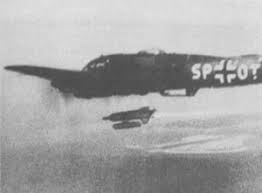
The Germans had just started testing a new guided missile, the Henschel Hs 293, (an airborne launched rocket – pictured – nicknamed by the Navy, ‘a Chase-me- Charlie’). It had a range of up to 11 miles, and guided to its target by the Luftwaffe pilot.
On board the Egret, which had electronic surveillance, were four RAF technicians involved in discovering more about the missile, which had been used two days earlier against The 40th Support Group, when two other ships, the Landguard and the Bideford were hit and damaged.
The Egret’s sinking led to anti-U-boat patrols in the Bay of Biscay being suspended, after which the Navy employed smoke screens and short range fire in an effort to reduce the missiles’ effectiveness.
What happened on that tragic day, in the Bay of Biscay was to revolutionize naval warfare, as was to be seen later in the Falklands’ War, where the Exocet was to cause such damage…”
An imperial War Museum picture dramatically captures the destruction of Egret…
https://www.iwm.org.uk/collections/item/object/205152071
As the cutting from the Bexleyheath Observer in November 1943 shows, in a letter to his mother at 19 Granville Road, “your son lost his life when the ship in which he was serving was sunk by enemy action while on patrol in the Atlantic and the circumstances of her loss make it extremely unlikely that there will be any survivors”…
Water was born on 21st May 1924, the son of Arthur Walter Targett – an ‘Iron Moulder Heavy Worker’ – and Emma Sarah Targett – the family lived at 1 Welling High Street. He was baptised at St. Michael’s in June 1924. A sister, Joan, was born the following year.
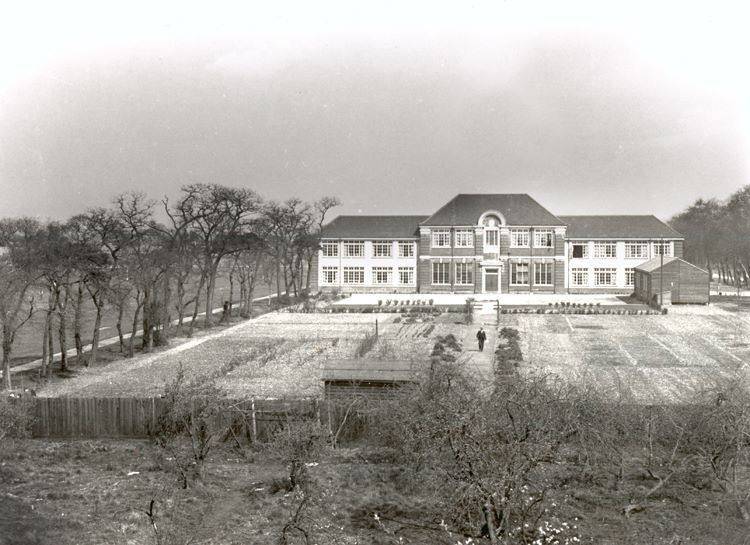
Educated at Bexleyheath Central School, (pictured), young Walter was serving as an apprentice at Woolwich Arsenal before volunteering to join the Royal Navy.
194 Royal Navy crew members were lost on HMS Egret – their names, along with Walter’s, are recorded on Portsmouth’s Memorial.
Portsmouth Naval Memorial
“After the First World War, an appropriate way had to be found of commemorating those members of the Royal Navy who had no known grave, the majority of deaths having occurred at sea where no permanent memorial could be provided.
An Admiralty committee recommended that the three manning ports in Great Britain – Chatham, Plymouth and Portsmouth – should each have an identical memorial of unmistakable naval form, an obelisk, which would serve as a leading mark for shipping. The memorials were designed by Sir Robert Lorimer, who had already carried out a considerable amount of work for the Commission, with sculpture by Henry Poole. The Portsmouth Naval Memorial was unveiled by the Duke of York (the future George VI) on 15 October 1924.
After the Second World War it was decided that the naval memorials should be extended to provide space for commemorating the naval dead without graves of that war, but since the three sites were dissimilar, a different architectural treatment was required for each. The architect for the Second World War extension at Portsmouth was Sir Edward Maufe (who also designed the Air Forces memorial at Runnymede, and was a one-time resident of Bexley’s Red House) and the additional sculpture was by Charles Wheeler, William McMillan, and Esmond Burton. The Extension was unveiled by the Queen Elizabeth, the Queen Mother on 29 April 1953.
Portsmouth Naval Memorial commemorates around 10,000 sailors of the First World War and almost 15,000 of the Second World War.”
………………………………………………………………………………………………………………………………………………………………..
If anyone is able to add any extra information, provide more family details, or suggest any corrections, please let us know – also, if anyone has any more photos of this individual listed on our memorials, please get in touch. Thank you.

Commemorated
- Welling War Memorial
- Portsmouth Naval Memorial
This story has been researched by volunteers. We have taken every effort to ensure its accuracy. If you are related to Walter Frank Targett, or if you have any further information, please do get in touch.